Roofing Contractor Insurance
Insurance built for roofing contractors.
Roofing Guard Insurance insures the business owners of roofing companies across the way they work — the residential crews running steep-slope, shingle, and re-roof jobs; the commercial and industrial contractors on low-slope and flat roofs with their hot-work and torch-down exposure; and the specialty metal and tile installers whose craft and material cost set them apart. One specialty program built around the exposures a generic policy leaves out.
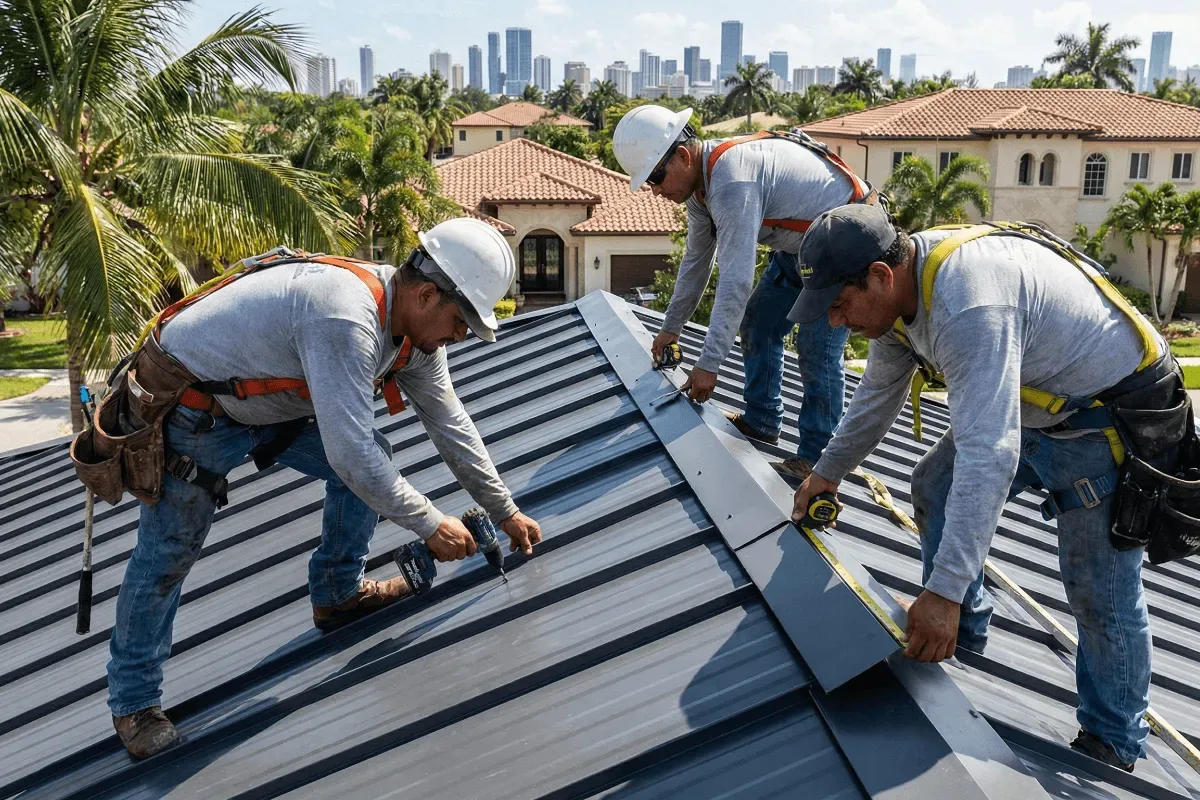

Three kinds of roofing business — one specialty program
Residential, commercial and industrial, and specialty metal and tile roofers run different risk profiles and lead with different coverage lines. We write each to its own operation, not off one generic form.
Residential Roofing Insurance
steep-slope roofing, asphalt shingle, architectural shingle, re-roofs and tear-offs, storm and hail repair
Insurance for roofing contractors serving homeowners — steep-slope, shingle and architectural work. The residential market segment, where completed-operations exposure on installed work, storm and re-roof volume, and a crew working at height on occupied homes drive the risk profile. This page is ABOUT the contractors who serve homeowners — never homeowner insurance.
Learn more →Commercial and Industrial Roofing Insurance
low-slope and flat roofing, TPO and EPDM membrane, built-up roofing, modified bitumen, torch-down and hot-work
Insurance for commercial and industrial roofing contractors — low-slope and flat work in TPO, EPDM, built-up, and modified bitumen. The commercial market segment, where hot-work and torch-down fire concentration, larger contract values, and additional-insured and wrap-up requirements drive the risk profile.
Learn more →Specialty, Metal, and Tile Roofing Insurance
standing-seam metal, metal roofing, clay tile, concrete tile, slate and premium roofing
Insurance for specialty roofing contractors — standing-seam and metal roofing and clay or concrete tile installation. The craft-specialty market segment, where high material cost and installation-precision exposure, and the completed-operations risk on a premium installed roof, drive the risk profile.
Learn more →Coverage for roofing contractors
The core lines a roofing business carries — led by the two that define this class: general liability built around completed operations and hot-work fire, and workers compensation for a crew that works at height.
General Liability Insurance
Third-party bodily injury and property damage coverage for roofing contractors — built around products-completed-operations (a roof that leaks or fails downstream after the job is done, causing third-party property damage or injury — the roofing trade’s defining GL exposure) and the hot-work and torch-down fire exposure during operations. The signature general liability page for the roofing trade.
Learn more →Workers Compensation Insurance
Medical and lost-wage coverage for roofing crews working at height — with honest handling of the four monopolistic state-fund states and the falls-from-height injury profile that makes roofing one of the highest-severity workers compensation classifications of any trade. A signature line for the roofing trade.
Learn more →Commercial Auto Insurance
Coverage for the crew trucks and trailers a roofing operation runs between the shop and the jobsite — the mobile-trade exposure of a fleet that hauls crews, tear-off debris, materials, and equipment on the road every working day.
Learn more →Contractors Equipment Insurance
Inland marine coverage for the tools, equipment, and materials a roofing contractor owns — on the jobsite, in the yard, and in transit — from ladders, harnesses, and nail guns to standing-seam machines, and the roofing materials staged for the next pour of work.
Learn more →Umbrella Liability Insurance
Excess limits above general liability, commercial auto, and other underlying policies for roofing contractors — and the higher limits that general contractors, developers, and project contracts often require of their roofing subcontractors.
Learn more →Built for how roofing businesses actually carry risk
The signature exposures of this trade are the work you leave behind and the crew working above the ground — not just the slip-and-fall a generic policy is priced for.
A roof that leaks or fails after you install it is the exposure that defines this trade
The biggest risk on installed roofing work is not a slip on the jobsite — it is a roof that leaks, fails, or lets water in after the crew has left and causes third-party property damage or injury downstream. That is the products-completed-operations side of general liability, and on roofing it is the exposure that matters most. It is joined by the hot-work exposure that concentrates in commercial and industrial work: a torch-down or hot-work operation that starts a fire during the job. We build the general liability program around both.
General liability & completed operations →Roofing is a working-at-height trade, and workers compensation is where that shows up
Because the crew works at height, roofing carries one of the most severe workers compensation risk profiles of any trade — a fall is the exposure the program has to be built around, not an afterthought. That makes how the policy is written, how the class is rated, and how loss control is handled matter more than they do for a ground-level trade. We also flag the four monopolistic states — North Dakota, Ohio, Washington, and Wyoming — where private carriers cannot write comp at all and coverage comes only through the state fund.
Workers compensation for roofing crews →Roofing insurance guides
Plain-language guides on coverage, cost drivers, licensing by state, and running a residential, commercial, or specialty roofing business.
Licensed in 48 states
We place coverage for roofing contractors across the country (every U.S. state except Hawaii & Alaska) — wherever your crews, your trucks, and your jobs are. Priority states are highlighted.
- Alabama
- Arizona
- Arkansas
- California
- Colorado
- Connecticut
- Delaware
- Florida
- Georgia
- Idaho
- Illinois
- Indiana
- Iowa
- Kansas
- Kentucky
- Louisiana
- Maine
- Maryland
- Massachusetts
- Michigan
- Minnesota
- Mississippi
- Missouri
- Montana
- Nebraska
- Nevada
- New Hampshire
- New Jersey
- New Mexico
- New York
- North Carolina
- North Dakota
- Ohio
- Oklahoma
- Oregon
- Pennsylvania
- Rhode Island
- South Carolina
- South Dakota
- Tennessee
- Texas
- Utah
- Vermont
- Virginia
- Washington
- West Virginia
- Wisconsin
- Wyoming
Roofing contractor insurance FAQ
Does general liability cover a roof that leaks or fails after I install it?
That is the products-completed-operations side of general liability, and on installed roofing work it is the exposure that matters most. A roof you installed or repaired that later leaks, fails, or lets water in and causes third-party property damage or injury is what this part of the policy is built to respond to. How the policy is triggered — on an occurrence basis versus a claims-made basis — changes how a claim that surfaces after the job is finished is handled, which is exactly the nuance we walk owners through.
What happens if a torch-down or hot-work operation starts a fire on the job?
The hot-work and torch-down fire exposure concentrates in commercial and industrial roofing, where a torch or hot-work operation can ignite a fire during the job. It is a general liability exposure, and it is one of the reasons a roofing program should not be written off a generic contractor form. We underwrite it as part of the general liability program rather than treating it as an afterthought.
Why is workers compensation such a big deal for a roofing business?
Because the crew works at height, roofing sits among the most severe workers compensation classes of any trade — a fall is the exposure the program is built around. Workers comp also follows your payroll, so the state a crew member physically works in matters as much as the state you are based in. We flag the four monopolistic states — North Dakota, Ohio, Washington, and Wyoming — where private carriers cannot write comp at all and coverage comes only through the state fund.
Are my crew trucks, tools, and materials covered on the road and on the jobsite?
Those are two different lines. Commercial auto answers the crew trucks and trailers that run between the shop and the jobsite every working day — the mobile-trade exposure a personal or generic policy is not built for. Contractors equipment, an inland marine line, answers the tools, ladders, harnesses, standing-seam machines, and staged materials on the jobsite and in transit. A roofing program should carry both, matched to how you actually run the operation.
Do roofing contractors need a license?
It depends entirely on the state. Some states license roofing contractors specifically, some cover the work under a general or specialty contractor license, some handle it through local registration only, and some do not license it at all. Because it varies so much, the honest answer is state-by-state — we confirm what your specific state and locality require rather than assuming a single national rule, and we never point you at a license that does not exist.
How much does roofing contractor insurance cost?
There is no single price, because premium is driven by your specific operation. The biggest factors are your payroll and crew classifications — roofing is a high-severity workers compensation class — along with your revenue, the type of roofing you do and its end use, whether you run steep-slope or hot-work operations, the number and value of your crew trucks, and your prior claims history. A residential shingle crew, a commercial flat-roof contractor, and a metal or tile specialist each look very different to an underwriter. We price to the real risk rather than a generic guess.
Who we are
Roofing Guard Insurance is a specialty brand of Wexford Insurance, an independent agency led by Nate Jones, CPCU. We focus on one class — roofing contractors, across residential, commercial and industrial, and specialty metal and tile work — and place coverage with carriers that actually want the work.
Our specialty panel spans 16 markets we hold appointments with, including: Cincinnati Insurance, Progressive Insurance, West Bend Insurance, GEICO, Secura Insurance, Westfield Insurance, ICW Group, Nautilus Insurance, Penn National Insurance, Kinsale Insurance, Crum & Forster, Lio Specialty Insurance Company, Berkley Industrial, Markel Insurance Company, Texas Mutual, Pie Insurance. We review the panel regularly and adjust it as carrier appetite shifts.
Roofing contractors don’t fit a generic business policy. The work you leave behind is the risk — a roof that leaks or fails downstream is a completed-operations claim, not a slip on the jobsite — and a crew working at height makes workers comp the line that can make or break the year. We built Roofing Guard because the coverage has to match how a roofer actually operates, whether that’s residential shingle work, commercial flat roofs, or metal and tile, not a one-size-fits-all form.
— Nate Jones, CPCU, Founder
Roofing Guard Insurance is a DBA of Wexford Insurance, LLC. Verify our license — NPN 19887690 — at NIPR.com.
Get a quote for your roofing business
Tell us how you operate — the roofs you install, the crews on your jobs, and the trucks you run — and we will market it to carriers that write the class.