Coverage line
Umbrella Liability Insurance for Roofing Contractors
Excess liability that sits above your primary policies and adds limit over them — general liability, commercial auto, and the employers-liability side of workers compensation. For a roofing contractor it is the answer to severity: a fall, a torch-down fire, or a roof that fails downstream can be the kind of large claim that exhausts a primary limit, and umbrella is the layer that responds above it.

Umbrella liability — also called excess liability — is the coverage that adds height above your primary policies. It does not answer a claim from the first dollar and it does not stand in for any policy you already carry. It sits above them, and it responds when a single large claim runs past the limit of the policy underneath it. For a roofing contractor that is the direct answer to the severity this trade carries, because roofing produces the kind of catastrophic-potential loss that can exhaust a primary limit and leave the balance to the business.
This page explains how the umbrella stacks above your primary policies, what it means to follow form over an underlying schedule, and — the spine of the page — why roofing’s severity drives the need for excess limits. It closes on the contract requirements placed on roofing subs, and draws the honest seam: the umbrella sits excess of your primary lines, it does not replace them.
How the excess stack works
Think of your liability program as layers. The bottom layer is your primary coverage — the policies that respond from the first dollar of a covered claim, each with its own limits and terms. For a roofing contractor those primary layers are general liability, which answers third-party bodily injury and property damage from your work; commercial auto, which answers the crew trucks and trailers on the road; and the employers-liability side of workers compensation, which answers the liability exposure that sits alongside the medical-and-wage benefits your crew is owed.
The umbrella is the layer above all of them. When a primary limit is exhausted by a large claim — the general liability limit used up by a serious completed-operations loss, the commercial auto limit by a severe road accident, the employers-liability limit by a catastrophic injury — the umbrella responds above that primary layer, up to its own limit. The primary policy pays first, and when a claim runs past it, the umbrella picks up above it. One umbrella can commonly sit over several underlying policies at once, so a single excess layer adds height across all three lines rather than needing a separate policy for each.
Follow-form and the underlying schedule
A commercial umbrella commonly follows form, which means it typically covers what the policies beneath it cover, at higher limits — it follows the terms of the underlying coverage. That is the general idea, and it is a useful way to picture the layer. But it is worth being precise, because the details are where an owner can get surprised: umbrella and excess policies can carry their own conditions and exclusions, so an umbrella is not simply a larger photocopy of your primary policy. How closely it follows form, and where it departs from the underlying wording, depends on the specific policy you are quoted.
Umbrellas also almost always require the underlying policies to be kept in force at scheduled minimum limits. Those requirements are usually spelled out on what is often called the schedule of underlying insurance — the list of primary policies the umbrella expects to sit on top of, at the limits it expects them to carry. If a primary limit drops below what the schedule requires, or a required underlying policy lapses, the umbrella can end up responding as if that limit were still in place, leaving a gap the business absorbs. Confirming your general liability, commercial auto, and employers-liability limits meet what the excess layer expects is exactly the check we run before binding, not after a claim tests it.
Why roofing’s severity drives the need for excess limits
This is the heart of the page. Almost any business can imagine a large claim, but roofing carries a specific cluster of exposures with genuine catastrophic potential — losses that can be severe enough to exhaust a primary limit. Three of them define the trade, and each one is a reason the excess layer matters.
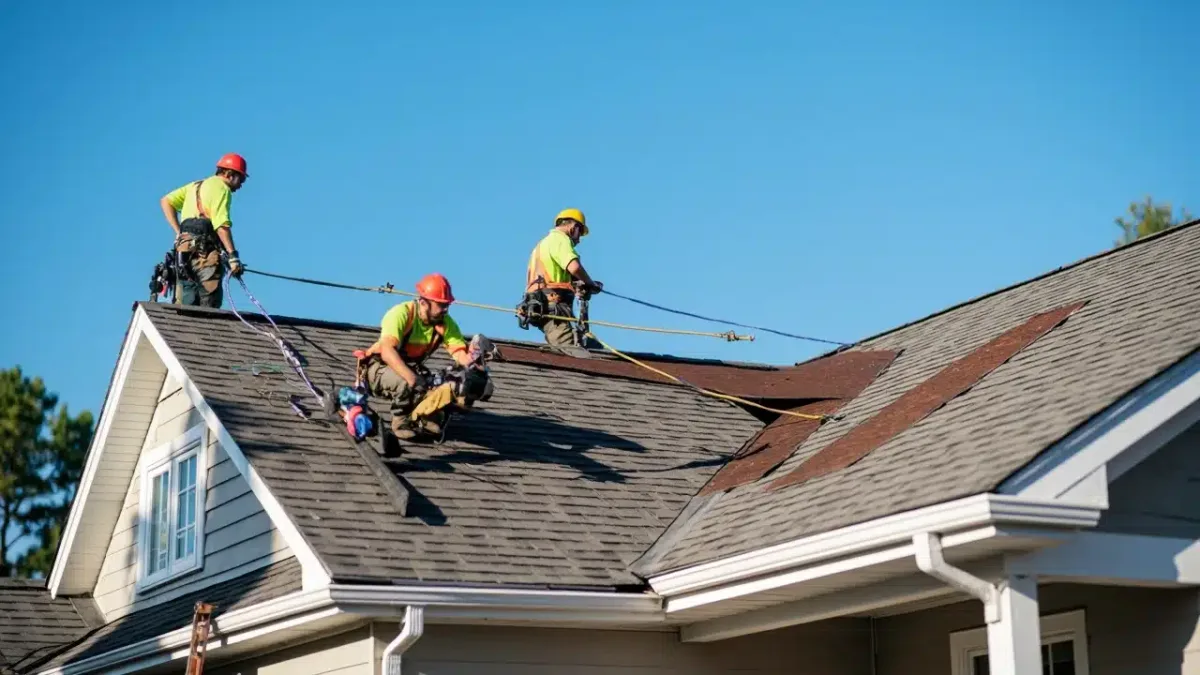
The fall. A fall from height is the signature severe injury of roofing, and it is the reason the trade is rated as heavily as it is. A serious fall can produce the kind of catastrophic bodily-injury claim whose severity runs past a primary limit — whether it reaches the umbrella through the employers-liability side of workers compensation for an injured crew member, or through general liability where a third party is the one who is hurt. Height is the defining condition of the work, and height is where severity concentrates.
The hot-work or torch-down fire. On the Commercial and Industrial Roofing side of the trade, low-slope and flat work frequently involves open-flame hot work — a torch on a torch-down system, hot asphalt, heat welding. When that ignites the roof deck, the insulation, or the building, the result can be a fire that becomes a large third-party property loss, potentially a whole-building loss. A fire claim of that size is precisely the kind that can exhaust a primary general liability limit — and it is one of the clearest reasons a commercial roofing operation carries excess limits above the primary layer.
The completed-operations failure. The roof you install keeps existing after you leave the site, and a failure in it can surface as a serious third-party claim downstream — water into a building and its contents, a structure damaged, someone injured by a roof that fails. Because roofing carries a long completed-operations tail, a single downstream failure can become a claim whose severity draws hard against the primary limit. The excess layer is the height that answers when it does.
None of these needs a fabricated statistic to make the point. Roofing produces high-severity losses more readily than an ordinary trade, and high-severity losses are exactly what exhaust primary limits. Umbrella liability is the coverage that matches that severity — the height above the primary layer that responds to the large claim instead of leaving the balance to the business.
When your contracts require it
For many roofing contractors, the first reason an umbrella goes on the schedule is not a loss — it is a contract. Roofing contractors routinely work as subs under general contractors, developers, and project owners, and those parties frequently require their roofing subcontractors to carry excess or umbrella limits above the primary general liability and commercial auto layers. The requirement is written into the subcontract and enforced through the certificate of insurance, and the excess limit demanded varies by the contract, the project, and the party requiring it.
That makes the contracts on your books a practical driver of how much excess limit you carry: the work you want to win often sets the floor, because you cannot bind the job without meeting the limit the contract demands. We read those requirements against your program before you need to produce a certificate, so an excess-limit requirement lands as something already handled rather than a scramble that stalls a job.
Where umbrella stops: it sits above, it does not replace
The seam that matters most on this page is the simplest to state and the easiest to misread. Umbrella liability is excess, not primary. It sits above your general liability, your commercial auto, and the employers-liability side of your workers compensation — and it responds only after one of those underlying policies is exhausted, or where the underlying schedule calls it in. It does not do the first-dollar work, and it does not stand in for a primary line you are missing.
That has a practical consequence: the umbrella is only as sound as the primary layer beneath it. Because most umbrellas require the underlying policies to be kept in force at scheduled minimum limits, a gap or a lapse in a primary policy can undercut the umbrella on top of it. This page does not re-litigate what each primary line covers — those pages each own their own exposure. What the umbrella adds is height over all of them: the extra limit that answers the severe claim the primary layer cannot absorb on its own.
Why roofing contractors need it
What sets this class apart is severity. A fall from height, a torch-down fire, and a completed-operations failure are the exposures the trade is built around, and each can produce a claim large enough to exhaust a primary limit. Umbrella liability is the layer that answers when one of them does, and it is frequently the layer your contracts require before a general contractor, developer, or project owner will let your crews on the job. The two reasons reinforce each other: the same severity that makes an excess layer prudent is what those contracts protect against when they demand it.
Because the severity profile differs by the roofing you do, the excess layer is read against the operation. A Residential Roofing contractor carries the fall exposure on steep-slope work and the completed-operations tail on installed roofs. A Commercial and Industrial Roofing contractor adds the hot-work and torch-down fire exposure that concentrates on low-slope work, with the larger contract values and excess-limit demands that come with commercial jobs. A Specialty, Metal, and Tile Roofing operation carries the completed-operations severity on a premium installed roof. We structure the excess layer to the real operation and the real contracts.
What umbrella liability responds to
These are the categories an underwriter expects on a roofing excess-liability file — described qualitatively, with generic carrier language and no fabricated cost, limit, or frequency figures.
- Excess general liability. Additional limit above your primary general liability — the height that answers a completed-operations roof failure or a hot-work fire whose severity exhausts the primary limit.
- Excess commercial auto. Additional limit above your primary commercial auto — the height for a severe road accident involving the crew trucks and trailers that runs past the underlying limit.
- Excess employers liability. Additional limit above the employers-liability side of workers compensation — the height for a catastrophic injury claim that runs past the underlying employers-liability limit.
- Follow-form excess over the underlying schedule. Coverage that typically follows the terms of the scheduled underlying policies at higher limits, subject to the umbrella’s own conditions and exclusions.
- Contract-required excess limits. The excess or umbrella limits general contractors, developers, and project owners require of their roofing subcontractors, satisfied at the limits the contracts demand.
Limits and structure
An umbrella is written as a single excess limit that sits above a schedule of underlying policies, each kept in force at its scheduled minimum. The right structure is driven by the work you do — the severity of the roofing you take on, the buildings you work on, the completed-operations tail your installed roofs carry, and, heavily, the excess-limit requirements written into your contracts. Rather than quote a number, we read what your contracts actually demand, confirm your primary limits meet what the umbrella’s underlying schedule expects, and build the excess layer to satisfy both.
Why Roofing Guard Insurance
We are an independent agency that writes one class — roofing contractors — and we place coverage with carriers that actually want the work. We know to read how your umbrella sits over your general liability, commercial auto, and employers-liability limits; to check whether it follows form over the underlying schedule and where it carries its own terms; to confirm your primary limits meet what the umbrella expects underneath it; and to set the excess limit to match what your contracts require. When a general contractor lands a certificate request on your desk demanding an excess limit you do not currently carry, that is a call we take. Start with a quote, or talk it through with us first.
Learn more
Coverage for a roofing business works as a system. Umbrella liability sits above general liability for the completed-operations and hot-work exposures, commercial auto for the crew trucks, and the employers-liability side of workers compensation for the crew and the falls exposure, while contractors equipment covers your tools and materials as a separate line. How the excess layer is structured also differs by the roofing you do across the three service pillars — Residential Roofing Insurance, Commercial and Industrial Roofing Insurance, and Specialty, Metal, and Tile Roofing Insurance.
Coverage for roofing contractors
- General Liability Insurance
- Workers Compensation Insurance
- Commercial Auto Insurance
- Contractors Equipment Insurance
Insurance by the roofing you do
- Residential Roofing Insurance
- Commercial and Industrial Roofing Insurance
- Specialty, Metal, and Tile Roofing Insurance
Get covered
Primary sources
Frequently asked questions about Umbrella Liability Insurance
What does umbrella liability sit over for a roofing contractor?
Umbrella — or excess — liability sits above your primary liability policies and adds limit over them. For a roofing contractor it typically sits excess of general liability, commercial auto, and the employers-liability side of workers compensation. It does not replace any of those policies; it responds after one of them is exhausted. When a large claim — a serious fall, a torch-down fire, or a roof that fails downstream — burns through the primary limit, the umbrella responds above it up to its own limit. The primary policies still do the first-dollar work; the umbrella is the extra height for the claim that goes past them.
What does “follow-form” mean on an umbrella policy?
A commercial umbrella commonly “follows form,” meaning it typically covers what the underlying policies cover, at higher limits — it follows the terms of the policy beneath it. In practice, though, umbrella and excess policies can carry their own conditions and exclusions, and they usually require the underlying policies to be kept in force at scheduled minimum limits, listed on what is often called the schedule of underlying insurance. So an umbrella is not simply a bigger copy of your primary policy — how closely it follows form, and where it has its own terms, depends on the wording of the policy you are quoted. Reading the umbrella against its underlying schedule is exactly the check we do before binding.
Why does roofing’s severity make excess limits matter?
Because roofing carries exposures with catastrophic potential — the kind of loss that can be large enough to exhaust a primary limit. Three stand out: a fall from height, the signature severe injury of the trade; a hot-work or torch-down fire that can become a building loss; and a completed-operations failure, where a roof you installed fails downstream and causes serious third-party harm. Any one of those can produce a claim larger than a primary general liability, commercial auto, or employers-liability limit. Umbrella liability is the height above the primary layer that answers for the severe claim rather than leaving the balance to the business. It is the coverage that matches the severity roofing actually carries.
How much umbrella limit does a roofing contractor need?
There is no single number, and we do not quote one blindly — the right limit is driven by two things: what your contracts require and what your exposure looks like. General contractors, developers, and project owners frequently require their roofing subcontractors to carry excess limits at specified amounts, so the contracts on your books often set the floor. On top of that, the severity of the work — height, hot work, the value of the buildings you work on, and the completed-operations tail on your installed roofs — informs how much height above the primary layer makes sense. Rather than name an amount, we read what your contracts actually demand and structure the excess layer to satisfy them and the exposure behind them.
Does umbrella replace my general liability or commercial auto?
No. Umbrella is excess, not primary — it sits above your general liability, commercial auto, and the employers-liability side of workers compensation, and it responds only after the underlying policy is exhausted or where the underlying schedule requires. Those primary policies still do the first-dollar work and still carry their own limits, aggregates, and terms. The umbrella adds height over them; it does not stand in for them. In fact, most umbrellas require you to keep the underlying policies in force at scheduled minimum limits, because the umbrella is built to sit on top of a solid primary layer, not to be the layer.
Do general contractors require roofing subs to carry umbrella coverage?
Often, yes. General contractors, developers, and project owners regularly require their roofing subcontractors to carry excess or umbrella limits above the primary general liability and commercial auto limits, and the requirement is written into the subcontract. The exact limit demanded varies by the contract and the project, which is why the contracts on your books tend to set the excess limit you need to carry to win and keep the work. We read those requirements against your policies before binding, so a limit requirement on a certificate does not stall a job or cost you an account.
Get the excess limit your contracts require and your severity demands
Tell us the excess limits your contracts call for and the roofing you do, and we will structure the umbrella over your primary layer with carriers that write the class — height for the severe claim, not an assumption.