Coverage line
Workers Compensation Insurance for Roofing Contractors
The line built around roofing’s defining severity — a crew working at height. Workers compensation pays the medical care and lost wages when an employee is hurt on the job, and the fall from a roof is the injury this trade is rated so heavily for. This page covers what it pays, why it follows your payroll, how the four monopolistic state funds work, and where it stops.
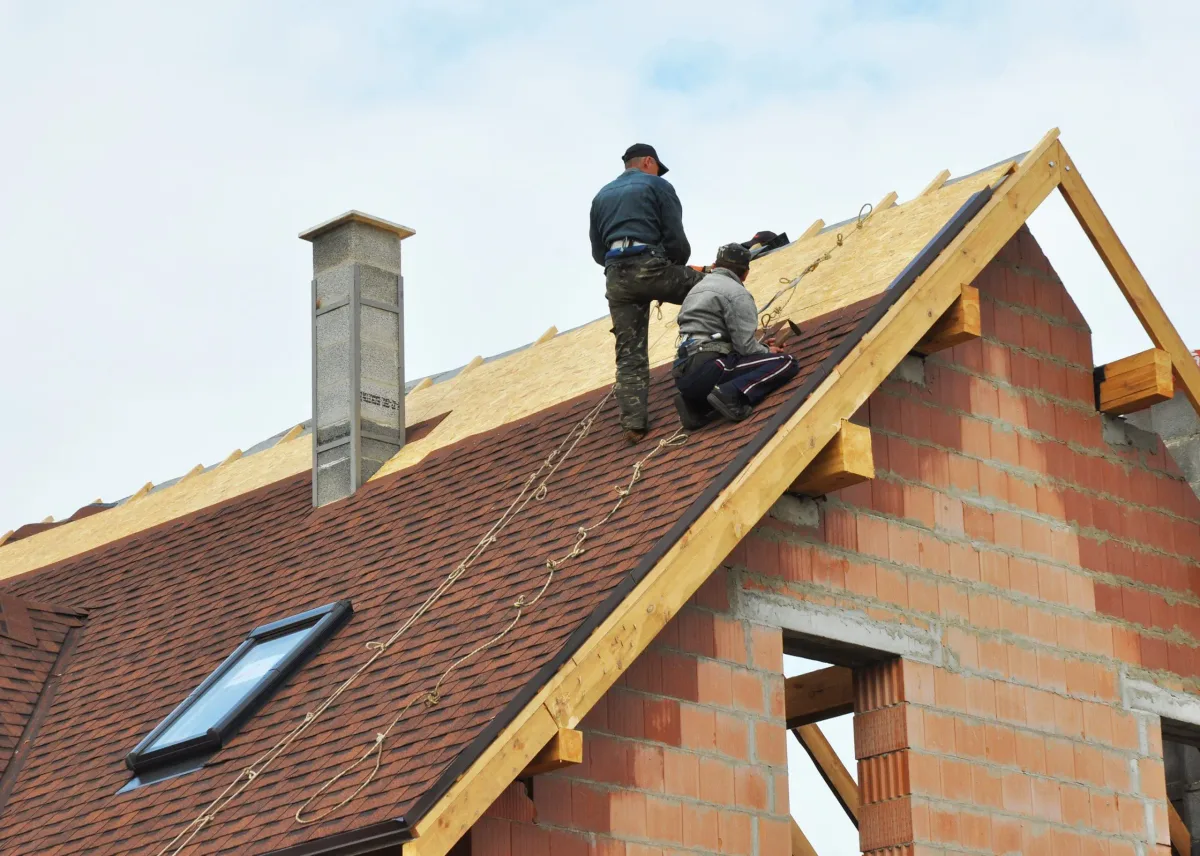

Workers compensation is the coverage that answers for your own people — the crew that gets on the roof. When an employee is hurt on the job, it pays the medical care the injury requires and a portion of the wages the crew member loses while unable to work, along with the benefits your state’s statute mandates for a lasting disability or a death on the job. It is a no-fault line: it responds whether or not anyone was careless, and in most states it is required the moment you have employees. For a roofing business it is not a formality — it is the coverage that stands between an injured crew member and the finances of the company.
And roofing carries one exposure that sets it apart from almost every other trade: the crew works at height. A fall from a roof, a ladder, or a scaffold is the signature injury of this business, and because that risk is present every working day, roofing sits among the highest-severity workers compensation classifications of any trade. That single fact is why this is a signature coverage page. This page covers what workers compensation pays, walks through the falls exposure the whole program is built around, explains the experience-modification factor and why loss control shows up in what the coverage costs, handles the four monopolistic state funds honestly, and draws the seam where workers compensation stops and general liability begins.
What workers compensation pays for
Workers compensation is a statutory line — its benefits are set by each state’s law rather than negotiated policy by policy — but the shape of what it pays is consistent. When a crew member is injured on the job, it covers the medical treatment the injury requires, from the emergency care after a fall through the surgery, therapy, and follow-up that a serious injury demands. It replaces a portion of the lost wages the employee cannot earn while recovering. And it carries the statutory benefits your state mandates for a permanent disability that keeps a crew member from returning to the work, or for a death on the job that leaves a family behind.
In exchange for those benefits, workers compensation is generally the exclusive remedy an injured employee has against the business: the employee is paid without having to prove fault, and the employer is protected from being sued directly for the workplace injury in most circumstances. For a high-severity trade, that exclusive-remedy protection is not a small thing.
The signature exposure: falls from height
This is the section worth slowing down on, because the fall is the exposure the entire program is built around. Roofing is defined by working at height — steep-slope crews on a pitched residential roof, low-slope crews near the edge of a flat commercial deck, everyone moving material up and down ladders and across surfaces that are wet, iced, sloped, or unfinished. A fall from that height is not a minor injury; it is the kind of loss that can be catastrophic or permanent, and it is the reason roofing is rated the way it is.
We describe this plainly and without dressing it in statistics, because it does not need them. A fall from a roof is among the most serious injuries in the building trades, and it is the exposure that makes roofing one of the highest-severity workers compensation classifications of any occupation. The rating system reflects that severity: because the classification carries a genuinely high-hazard profile, its cost is higher than a low-hazard trade’s, and honestly so — the rate is answering for a real risk, not an inflated one.
The falls exposure also shapes how the coverage should be underwritten. A crew working at height needs its workers compensation placed by someone who treats the class as the high-hazard work it is — who asks about the fall-protection program, the tie-off practices, and the training the crew actually gets — rather than quoting it like a low-risk trade and being surprised at the first serious claim.
The experience-modification factor and why loss control pays
Roofing’s classification sets the starting point for what workers compensation costs, but your own record moves it. Most states apply an experience-modification factor — the experience mod — that adjusts your cost up or down based on how your actual claims history compares with the losses expected for a business of your class and size. A clean record over time can pull the mod below the class average; a run of serious claims pushes it above. Over the years, the mod becomes one of the largest levers a roofing contractor has over the cost of the coverage.
For a high-severity trade, that makes loss control more than a safety slogan — it is a financial lever. A real fall-protection program, disciplined tie-off and ladder practices, near-miss reporting, and a genuine return-to-work plan that gets a recovering crew member back on modified duty all work to reduce both the frequency and the severity of claims, and that shows up in the experience mod over time. A roofing business that invests in the crew’s safety is not only protecting its people; it is protecting the number that drives its workers compensation cost. We talk through that side of the program with owners rather than treating the coverage as a bill that arrives with no way to influence it.
Coverage follows the payroll: the state where the crew works
Workers compensation is priced on payroll and governed by the state where the work is performed — the coverage follows the crew. That is straightforward for a roofing business that works in one state, but roofing chases storm and re-roof demand, and crews cross state lines. When they do, the state where a crew member actually performs the work generally governs the coverage that has to respond, which means a multi-state roofer needs a policy that lists the states it operates in and handles work in states it has only recently started crossing into.
Getting that right is not paperwork for its own sake — a crew injured in a state your policy does not properly cover is the gap nobody wants to find after a fall. Because the coverage is tied to where the work is done, we read a roofing program against how the crews actually move: the home base, the states worked regularly, and the neighboring states storm season pulls the crew into.
The four monopolistic state funds
There is a structural wrinkle a multi-state roofer has to handle honestly, and it is worth naming plainly. In four states — North Dakota, Ohio, Washington, and Wyoming — workers compensation is monopolistic: a private carrier cannot write it. Coverage in those states comes only through the state fund — North Dakota’s WSI, Ohio’s BWC, Washington’s L&I, and Wyoming’s program — rather than through a private policy.
For a roofing contractor that operates in one of those four states, the statutory workers compensation is obtained through the state fund. For a business that crews across state lines, it means carrying private coverage for the states where private carriers write and arranging state-fund coverage for any of the four monopolistic states the crew works in — because a private policy simply cannot cover the crew there. It is a real thing a growing roofer runs into, and one we account for so that no state’s crew is left without the statutory coverage it is owed.
Where workers compensation stops: the general liability seam
Some injuries look like they should be covered here and are not, and the most important line-drawing on this page is the one between your own crew and everyone else. Workers compensation answers injuries to your own employees — the people on your payroll, including the crew member who falls from the roof. It does not answer a third party.
An injury to your own employee — the fall — is a workers compensation claim; general liability answers third parties. A member of the public, a building owner, a delivery driver, or another contractor’s worker hurt around your work is a general liability claim, not a workers compensation one. The two lines are written together and work as a pair, but they answer different injuries: workers compensation for your own people on the roof, general liability for the third-party bodily injury your operation can cause. When someone asks whether workers compensation will cover a passerby hurt near the job, the honest answer is no — that is general liability — and knowing which line answers which injury before a loss is exactly the seam we walk every roofing contractor through.
Why roofing contractors need it
What separates this class from ordinary business risk is that the crew works at height every day, and a fall is the kind of injury that can be catastrophic — for the person first, and for the finances of the company right behind. Workers compensation is the line that pays the medical care and the lost wages when that happens, and in most states it is required the moment a roofing business has employees. It is also the coverage a general contractor or project owner will insist on before they let your crew on the site.
Because the exposure differs by the roofing you do, the coverage has to fit the operation. A Residential Roofing contractor puts crews on steep-slope, pitched roofs over occupied homes, where the fall exposure and the ladder-and-height work drive the profile. A Commercial and Industrial Roofing contractor runs larger crews and larger payroll on low-slope and flat work, where the height exposure sits alongside the hot-work and torch-down hazards of the commercial side. A Specialty, Metal, and Tile Roofing operation carries the same at-height severity on premium installed roofs, with skilled crews handling heavy metal and tile. The classification, the payroll, the states worked, and the loss record all feed the coverage — and writing it off a generic contractor assumption misprices the work and misreads the risk.
What workers compensation responds to
These are the categories underwriters expect on a roofing workers compensation file. They are described qualitatively and with generic carrier language — every claim is handled by the carrier or the state fund, never named here — with no fabricated cost, rate, or frequency figures.
- Falls from height. A crew member who falls from a roof, a ladder, or a scaffold — the signature and highest-severity injury of the trade, and the exposure the whole program is built around.
- Medical care and lost wages. The treatment an on-the-job injury requires and a portion of the wages a recovering crew member cannot earn — the core of what every workers compensation claim pays.
- The everyday on-the-job injuries. Strains and back injuries from lifting bundles, cuts and burns, heat illness on a summer roof, and the wear-and-tear injuries of physical, at-height work — the labor-heavy injury profile of roofing.
- Permanent disability and death benefits. The statutory benefits your state mandates when an injury keeps a crew member from returning to the work, or when a loss on the job leaves a family behind.
- Multi-state and monopolistic-state coverage. Statutory coverage in each state the crew works — through a private policy where private carriers write, and through the state fund in North Dakota, Ohio, Washington, and Wyoming.
Structure and cost drivers
Workers compensation is priced on your payroll and your classification, then adjusted by your experience-modification factor — and for a high-severity trade like roofing, all three matter: the classification reflects the at-height severity, the payroll reflects the size of the crew, and the experience mod reflects your own claims record over time. The states you operate in shape the structure too — a multi-state roofer arranges private coverage where private carriers write and state-fund coverage in the four monopolistic states. Rather than quote a number, we read the class, the payroll, the states, and the loss record against the work you actually do.
Why Roofing Guard Insurance
We are an independent agency that writes one class — roofing contractors — and we place coverage with carriers and, where the law requires it, alongside the state funds that answer for this work. That focus is the point. We know the falls-from-height exposure is the severity that defines the class, so we underwrite it honestly rather than treating roofing like a low-hazard trade; we read the experience-modification factor against your loss record and talk through the loss control and return-to-work practices that move it; and we account for the four monopolistic state funds when a crew works across state lines. When a general contractor lands a certificate request on your desk, or a storm pulls your crew into a new state, that is a call we take. Start with a quote, or talk it through with us first.
Learn more
Coverage for a roofing business works as a system. Workers compensation pairs most often with general liability for the third-party harm your work can cause, commercial auto for the crew trucks, contractors equipment for your tools and materials, and umbrella liability when an account demands limits above your underlying layers. How it is written also differs by the roofing you do across the three service pillars — Residential Roofing Insurance, Commercial and Industrial Roofing Insurance, and Specialty, Metal, and Tile Roofing Insurance.
Coverage for roofing contractors
- General Liability Insurance
- Commercial Auto Insurance
- Contractors Equipment Insurance
- Umbrella Liability Insurance
Insurance by the roofing you do
- Residential Roofing Insurance
- Commercial and Industrial Roofing Insurance
- Specialty, Metal, and Tile Roofing Insurance
Get covered
Primary sources
Frequently asked questions about Workers Compensation Insurance
What does workers compensation cover for a roofing contractor?
Workers compensation pays for an injury to your own employee that arises out of the work — the medical care the injury requires and a portion of the wages the crew member loses while unable to work, along with the benefits your state’s statute mandates for a lasting disability or a death on the job. It is a no-fault line: it responds whether or not anyone was careless, and in exchange it is generally the exclusive remedy an injured employee has against the business. For a roofing contractor the exposure it is built around is the fall from height — the signature injury of the trade — but it answers the full range of on-the-job harm, from a fall to a strain lifting bundles to heat illness on a summer roof. It does not cover a member of the public or another contractor’s worker hurt near your job; that third-party harm is general liability, a separate line.
Does workers compensation cover a crew member who falls off a roof?
Yes — and it is the exposure the whole policy is built around for this trade. A fall from a roof, a ladder, or a scaffold is the signature injury of roofing, and because the crew works at height every working day, roofing sits among the highest-severity workers compensation classifications of any trade. When a crew member falls and is hurt on the job, workers compensation pays the medical care and the lost wages, and its statutory benefits carry through a serious or permanent injury. It is precisely because the falls exposure is so severe that a roofing business should have its workers compensation placed by someone who underwrites the class honestly rather than treating it like a low-hazard trade.
Does workers compensation cover a passerby or another contractor hurt near my job?
No — and this is the seam every roofing contractor should understand. Workers compensation answers injuries to your own employees; it does not answer a third party. A member of the public, a building owner, a delivery driver, or another contractor’s worker hurt around your work is a general liability claim, not a workers compensation one. The two lines are written together but answer different injuries: workers compensation for your own crew — including the fall roofing is rated so heavily for — and general liability for the third-party harm your operation can cause. Reading that line before a loss is part of building the program.
How does workers compensation work in the monopolistic states?
Four states — North Dakota, Ohio, Washington, and Wyoming — are what the industry calls monopolistic: a private carrier cannot write workers compensation there, so the coverage comes only through the state fund (North Dakota’s WSI, Ohio’s BWC, Washington’s L&I, and Wyoming’s program). A roofing contractor operating in one of those states obtains statutory workers compensation through the state fund rather than a private policy, and a business that crews across state lines has to carry the private coverage for the states where it can and the state-fund coverage for the states where it must. It is a real structural wrinkle a multi-state roofer has to handle, and one we account for so no state’s crew is left without the statutory coverage it needs.
Why does workers compensation cost more for roofing than for other trades?
Two things drive it, and both are honest to the trade. The first is the classification: workers compensation is rated by the kind of work being done, and roofing is a high-severity, at-height class, so its rate reflects the fact that a fall can be catastrophic. The second is your own record. Most states apply an experience-modification factor — the experience mod — that adjusts your cost up or down based on how your actual claims history compares with the expected losses for your class. A clean loss record and real loss control can lower the mod over time; a run of serious claims raises it. For a high-severity trade like roofing, the experience mod is one of the strongest reasons a fall-protection program and a return-to-work plan are worth the effort — they show up in what the coverage costs.
Which state’s workers compensation applies when my crew works across state lines?
Workers compensation follows the payroll — the state where a crew member actually performs the work generally governs the coverage that has to respond. That matters for a roofing business that takes storm and re-roof work across state lines, because a crew working in a neighboring state may need coverage under that state’s rules, and one of the four monopolistic states adds the wrinkle that the coverage there comes only through the state fund. A policy that lists the states you operate in, and the way it treats work in states you have only recently started crossing into, is exactly the kind of detail we read against how your crews actually move before binding.
Get workers compensation built for a crew that works at height
Tell us whether you run steep-slope residential, low-slope hot-work, or specialty metal and tile, and the states your crews work, and we will place it with a market that underwrites the falls exposure honestly — monopolistic states handled.