Insurance by market segment
Commercial & Industrial Roofing Insurance for Flat-Roof Contractors
Insurance for the commercial and industrial roofing contractor — low-slope and flat work in TPO, EPDM, built-up roofing, and modified bitumen. The commercial segment is defined by two things at once: the hot-work and torch-down fire exposure of an open flame on a combustible, occupied building, and the additional-insured and excess-limit demands of the general contractors whose contracts you work under.
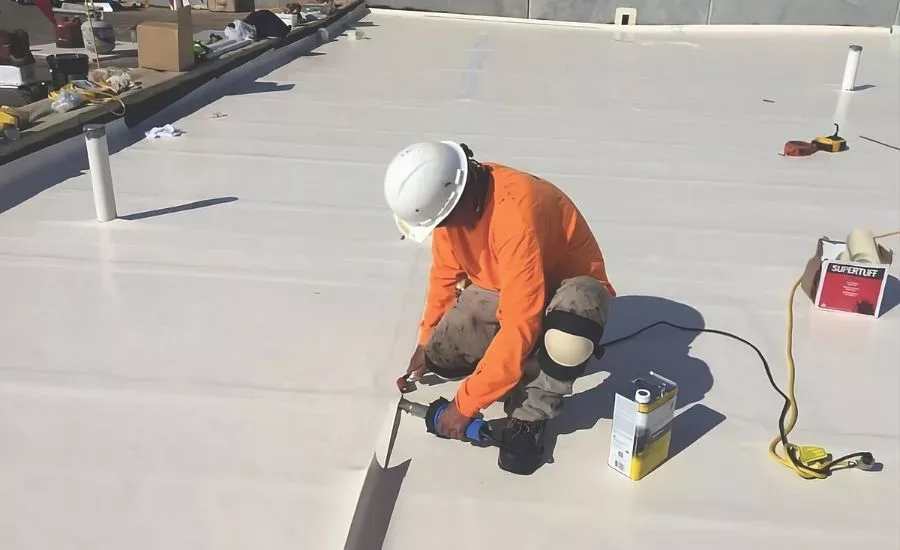

Commercial and industrial roofing is low-slope, flat-roof work — TPO, EPDM, built-up roofing, and modified bitumen laid across warehouses, plants, and occupied commercial buildings — and the exposure that defines it is heat: a torch-down, hot-asphalt, or heat-welding operation running an open flame directly on a combustible, occupied structure, where a single hot-work fire is the catastrophic loss the whole program is built to answer for. That is a risk picture a generic contractor policy does not anticipate, and it is the reason commercial roofing is written as its own segment rather than as a version of steep-slope work.
The second thing that sets this segment apart is the contract. Commercial roofers rarely work alone — most work as a subcontractor under a general contractor or construction manager whose contract dictates the insurance terms, demanding additional-insured status for both ongoing and completed operations and, on larger jobs, higher or excess limits your primary policy alone may not carry. Bidding, certificates of insurance, wrap-up and owner-controlled insurance programs, and after-hours work on occupied buildings are the operating reality of the trade. So this segment leads with two lines at once: general liability, for the hot-work fire and the completed-operations exposure and the additional-insured demands, and umbrella liability, for the higher limits the contracts require.
This page covers how commercial and industrial roofing insurance is built for that reality: the work it covers, the risk profile, the coverage stack in the order this segment leans on it, the drivers that move cost, and how carriers underwrite a hot-work roofing risk. If your operation also runs steep-slope residential shingle work, the Residential Roofing page is built for that segment; if you install premium standing-seam metal or clay and tile roofs, the Specialty, Metal, and Tile Roofing page is built for that one.
What makes commercial and industrial roofing insurance different
Two features separate this segment from every other kind of roofing, and both point the program toward the same place. The first is the hot-work fire severity. Steep-slope shingle work does not run an open flame on the deck; low-slope work frequently does — a torch on a modified-bitumen system, hot asphalt, or heat welding — and it does so on a building that is combustible and often occupied and operating around the crew. The single most serious loss in this segment is not a slip or a dropped tool but a fire, and a fire on a commercial or industrial building is the kind of third-party loss that can run straight past a primary limit into an umbrella.
The second is the contract structure. A commercial roofer bids and works under general contractors, construction managers, and owners whose contracts set the insurance terms — additional-insured status for ongoing and completed operations, certificate-of-insurance requirements, and limits that larger contracts and wrap-up programs push well above a primary layer. The consequence is that two commercial roofers with similar revenue can carry very different programs depending on the heat they run and the contracts they sign. We separate the hot-work fire exposure from the completed-operations exposure, and the primary limits from the excess the contracts demand, so none is mispriced — and we weight the stack toward general liability and umbrella, the two lines this segment actually leans on.
The work this covers
The commercial and industrial segment holds several kinds of low-slope and flat work that share one risk profile — a membrane or built-up system installed on a commercial or industrial building, frequently with heat. These are the operations that live within this pillar:
- Low-slope and flat roofing. The defining work of the segment — flat and low-slope systems on warehouses, plants, retail, and other commercial and industrial buildings, where the roof sheds water by membrane and slope rather than by shingle overlap.
- TPO and EPDM membrane. Single-ply membrane systems that are mechanically fastened, adhered, or heat-welded at the seams — where the seam and its long-term watertightness drive the completed-operations exposure.
- Built-up roofing. Multi-ply systems built with hot asphalt or cold-applied adhesives — hot-applied work that carries the fire exposure directly.
- Modified bitumen and torch-down. Modified-bitumen systems applied with an open-flame torch or hot air — the signature hot-work operation of the segment, and the one that concentrates the fire exposure.
- Occupied-building and after-hours work. Re-roofs and repairs on buildings that stay open and operating below the crew, often scheduled after hours — where the presence of people and property under the work raises the stakes on any loss.
Steep-slope residential shingle work is not part of this segment — it carries its own storm-and-re-roof profile and lives on the Residential Roofing page. Premium standing-seam metal and clay or tile installation is not part of it either — it is a craft-specialty profile that lives on the Specialty, Metal, and Tile Roofing page. If your operation runs commercial flat work alongside one of those, each scope is underwritten on its own terms.
State and regulatory considerations
A commercial roofing contractor sits at the intersection of two regulatory worlds. The first is worker safety: fall protection is the defining roofing safety regime, and the open edges, roof openings, and skylights of flat work, along with the fire-prevention and hot-work practices a torch operation demands, run through OSHA standards. A documented safety and hot-work program — fall protection, a fire watch, and the controls a torch-down job requires — is something carriers look for on a commercial roofing risk. The second is contractor licensing where it applies: roofing and contractor licensing varies genuinely by state — some states license roofing contractors specifically, some through a general or specialty contractor license, some through local registration only, and some not at all. We do not invent a license or a code that does not exist; we read the rule that actually applies in the states you work.
The commercial side adds its own layer. Prevailing-wage rules, wrap-up and owner-controlled insurance programs, and the additional-insured and limit requirements written into general-contractor and public contracts vary by state and by project, and they shape how a commercial roofer bids, insures, and documents the work. We read those requirements against your program rather than assuming a generic policy satisfies them. Workers compensation rules also vary by state, including the four monopolistic states — North Dakota, Ohio, Washington, and Wyoming — where coverage comes only through the state fund, which matters for a crew that works across a state line. As our state pages come online we link the worker-safety, licensing, and workers-compensation specifics for the states we serve; in the meantime we write across all 48 licensed states.
Coverage breakdown
Here is the stack a commercial and industrial roofing contractor carries, in the order this segment leans on it. Each line links to its full page — and because the commercial segment is defined by the hot-work fire and the contracts, general liability and umbrella lead the program.
- General Liability Insurance — the lead line. Third-party bodily injury and property damage from the work, the hot-work and torch-down fire exposure of an open flame on a combustible building, the completed-operations exposure when a finished roof leaks or fails downstream, and the additional-insured status — ongoing and completed operations — your general contractors require.
- Umbrella Liability Insurance — the excess layer. The higher limits general contractors, developers, construction managers, and wrap-up programs demand of a commercial roofing sub, sitting excess of general liability and commercial auto and answering the severity of a hot-work fire that can run past a primary limit.
- Commercial Auto Insurance — the crew trucks and trailers that run between the shop and commercial and industrial sites, hauling crews, membrane, tear-off, and equipment — the auto liability on the road and the physical damage that protects the fleet.
- Workers Compensation Insurance — medical and lost-wage coverage for a crew working at height on flat roofs, where open edges, roof openings, and skylights carry roofing’s falls-from-height exposure, with employers liability and honest handling of the monopolistic states.
- Contractors Equipment Insurance — inland marine coverage for the tools, membrane welders, and staged material a commercial roofer owns, on the jobsite, in the yard, and in transit.
What commercial and industrial roofing insurance costs
Premium tracks the operation, not a sticker price. The drivers that move it most are the share of your work that involves hot work — torch-down, hot asphalt, and heat welding — and the fire controls you run around it; the size and type of the contracts on your books and the limits they demand; whether you work under wrap-up or owner-controlled insurance programs; your payroll and the crew classifications a flat-roof operation covers; your loss history on both liability and auto; your multi-state footprint; and your fall-protection and hot-work safety discipline. We price to that real picture and stand behind any figure we give — verified ranges come from us directly, never a generic guess.
Claims scenarios
These are plausible commercial and industrial roofing claim categories, described qualitatively and with generic carrier language — every claim is handled by the carrier, never named here — and with no fabricated cost or frequency figures.
- A hot-work operation starts a fire. A torch or hot asphalt ignites the deck, the insulation, or the building on an occupied commercial or industrial structure, and the fire damages property and injures people who are not your crew — the catastrophic third-party general-liability loss that defines the segment, and the severity that drives the need for an umbrella above it.
- A finished roof leaks downstream. A membrane seam or a flashing detail opens after the job is done and water gets into the building and its contents — the completed-operations claim that answers the third-party harm your work causes.
- A general contractor makes a claim against your additional-insured status. A loss on the project pulls in the general contractor you added as an additional insured, and the ongoing or completed-operations endorsement your contract required responds — which is why reading the endorsements against the contract matters before binding.
- A crew truck is in an accident. A truck hauling crew and material to a commercial site is in a collision or is damaged — auto liability and physical damage on commercial auto.
- A crew member is hurt at height. A worker falls or is injured on a flat roof or at an open edge — a workers compensation claim for the crew.
Underwriting realities
Carriers writing the commercial roofing class look at the heat and the contracts and the discipline around both: the share of hot work in your operation and the fire controls you document, the type and size of the contracts you take on and the limits they demand, whether you run under wrap-up programs, your fall-protection program on flat work, your liability and auto loss history, and your multi-state footprint. A commercial roofer with a documented hot-work and fire-watch program, a clean liability record, and clear contract management opens more markets; heavy uncontrolled torch work, a fire or serious liability loss, or thin safety documentation narrows them. A contractor who also runs residential or specialty work gets that portion underwritten separately so the commercial book is not subsidizing — or stranding — the rest. We position your operation to the carriers most likely to want a hot-work roofing risk rather than sending one generic submission everywhere.
Why Roofing Guard Insurance
We write one class — roofing contractors — and within it we treat commercial and industrial work as the hot-work, contract-driven segment it is, not as a version of a residential roofer. We weight your stack toward the two lines this segment actually leans on: general liability for the hot-work fire, the completed-operations exposure, and the additional-insured status your general contractors require, and umbrella liability for the higher limits the contracts demand. We read your contracts against your endorsements before binding, underwrite the hot-work fire exposure as the catastrophic risk it is on flat work, and underwrite any residential or specialty work you also do on its own terms. When a general contractor lands a certificate request on your desk with completed-operations additional-insured requirements you do not recognize, that is a call we take. Start with a quote, or talk it through with us first.
Learn more
Commercial and industrial roofing is one of three market segments we write, and the coverage stack shifts with the work. The two lead lines for this segment live on the general liability page (the hot-work fire, completed operations, and the additional-insured endorsements) and the umbrella liability page (the excess limits general contractors require), with commercial auto, workers compensation, and contractors equipment as the supporting lines. If your operation also runs steep-slope residential shingle work, the Residential Roofing Insurance page leads with the storm-and-re-roof profile; if you install premium metal or tile, the Specialty, Metal, and Tile Roofing Insurance page leads with the material-cost and installation-precision profile.
Coverage for commercial and industrial roofing contractors
- General Liability Insurance
- Workers Compensation Insurance
- Commercial Auto Insurance
- Contractors Equipment Insurance
- Umbrella Liability Insurance
Insurance by the roofing you do
Get covered
Primary sources
Frequently asked questions about Commercial and Industrial Roofing Insurance
What insurance does a commercial or industrial roofing contractor need?
A commercial roofing program is built around the exposures of low-slope, flat work and the contracts you sign to get on the job. General liability leads it — the hot-work and torch-down fire exposure of an open flame on a combustible building, the completed-operations exposure when a finished roof leaks or fails downstream, and the additional-insured status your general contractors require. Umbrella liability sits above it for the higher limits larger contracts and wrap-up programs demand. Commercial auto covers the crew trucks and trailers that run to commercial and industrial sites, workers compensation covers a crew working at height on flat roofs, and contractors equipment covers the tools, membrane, and staged material. We weight the program toward general liability and umbrella, because that is where a commercial roofer’s exposure and contract demands actually concentrate.
What happens if a torch-down or hot-work operation starts a fire?
It is the catastrophic exposure that defines commercial and industrial roofing. Low-slope work often runs an open flame or high heat directly on the roof — a torch on a modified-bitumen system, hot asphalt, or heat welding — on a building that is combustible and frequently occupied, and when heat or flame reaches the deck, the insulation, the structure, or an adjacent property, the result is a fire that can spread into the building and its contents fast. We describe that severity plainly and qualitatively, without inventing statistics, because it does not need them. General liability is built to respond to the third-party bodily injury and property damage a hot-work fire causes — the building and contents that are not yours, and the people who are not your crew. The detail of how completed operations and the fire exposure work lives on our general liability page. The prevention side — a fire watch after the torches go cold, extinguishers within reach, and the hot-work practices the job demands — sits alongside the coverage, not in place of it.
My general contractor requires me to be added as additional insured — what does that mean?
Commercial roofers almost always work as a subcontractor under a general contractor or construction manager, and one of the first things that contract demands is additional-insured status on your general liability — usually for both your ongoing operations while you are on the roof and your completed operations after the work is done. A well-drafted contract requires both, because a general contractor wants protection while your crews are on site and after you have left, and commercial roofing carries a long completed-operations tail. The endorsements that add that status, and whether your policy carries them on a blanket basis where a written contract requires it, are exactly what we read against your contracts before binding. The mechanics of those additional-insured endorsements are explained in full on our general liability page.
Why do commercial roofing contractors carry umbrella or excess limits?
Because the contracts demand it and the exposure warrants it. General contractors, developers, construction managers, and the wrap-up or owner-controlled insurance programs on larger jobs frequently require limits well above what a primary general liability or commercial auto policy carries, and a bid can stall or be lost if you cannot meet the number on the certificate. Umbrella liability sits excess of your underlying policies and follows their form to add that limit. It also answers the severity side of the trade: a hot-work fire on an occupied commercial or industrial building is exactly the kind of loss that can run past a primary limit, which is why a commercial roofer tends to need real excess rather than a token layer. We size the umbrella to the contracts on your books and the work you take on.
How is commercial roofing insurance different from residential roofing insurance?
The roof and the contract both change. Residential roofing is steep-slope, shingle and architectural work on occupied homes, where completed-operations exposure on installed work and storm and re-roof volume drive the risk. Commercial and industrial roofing is low-slope, flat work in TPO, EPDM, built-up roofing, and modified bitumen — which introduces the hot-work and torch-down fire exposure that steep-slope shingle work does not carry — and it is done under general contractors and construction managers whose contracts demand additional-insured status and higher limits. So a commercial program leads with general liability and umbrella, where a residential program is weighted differently. If your operation also runs steep-slope residential work, that model lives on our residential roofing page, and each scope is underwritten on its own terms.
Does general liability cover a commercial roof that leaks or fails after the job is done?
That is the completed-operations side of general liability, and on installed roofing it is one of the exposures that matters most. A finished roof keeps existing — shedding water, taking wind uplift, aging — long after final payment, and a membrane seam that opens, a flashing detail that fails, or a roof that lets water into the building and its contents downstream is the kind of third-party claim completed operations is built for. What it does not do is simply pay to tear off and redo the defective work itself because it failed; the resulting harm to others is the insured event, not the rebuild of the roof you installed. That distinction, and how the occurrence-versus-claims-made trigger changes a claim that surfaces long after the job, is walked through in detail on our general liability page.
Does general liability cover a crew member who falls on a flat roof?
No — an injury to your own crew is a workers compensation claim, not a general-liability one. General liability answers third-party bodily injury and property damage: the people who are not your employees and the property that is not yours. A crew member who falls on a flat roof, off a ladder, or off the edge is answered by workers compensation, which is the line that carries roofing’s falls-from-height exposure. Low-slope work does not remove that exposure — open edges, skylights, roof openings, and the material and equipment moving across a flat roof all carry it — so a commercial roofer still needs workers compensation written alongside general liability, each covering the injuries it is built for.
Commercial and industrial roofing insurance by state
We write commercial and industrial roofing contractors in all 48 licensed states, with a single roofing-contractor state page for each — the local licensing, workers-compensation, and coverage picture for the state you work in. Priority markets include Texas, California, Florida, Ohio, and Indiana. Pick your state for the roofing-license posture, the hot-work and fall-protection regime, and the workers-compensation rules that apply to a commercial roofing crew where you work.
Insure the flat-roof work the way it runs
Tell us about the hot work you do, the contracts you bid, and the limits your general contractors demand, and we will market it to carriers that write the commercial and industrial roofing class.