

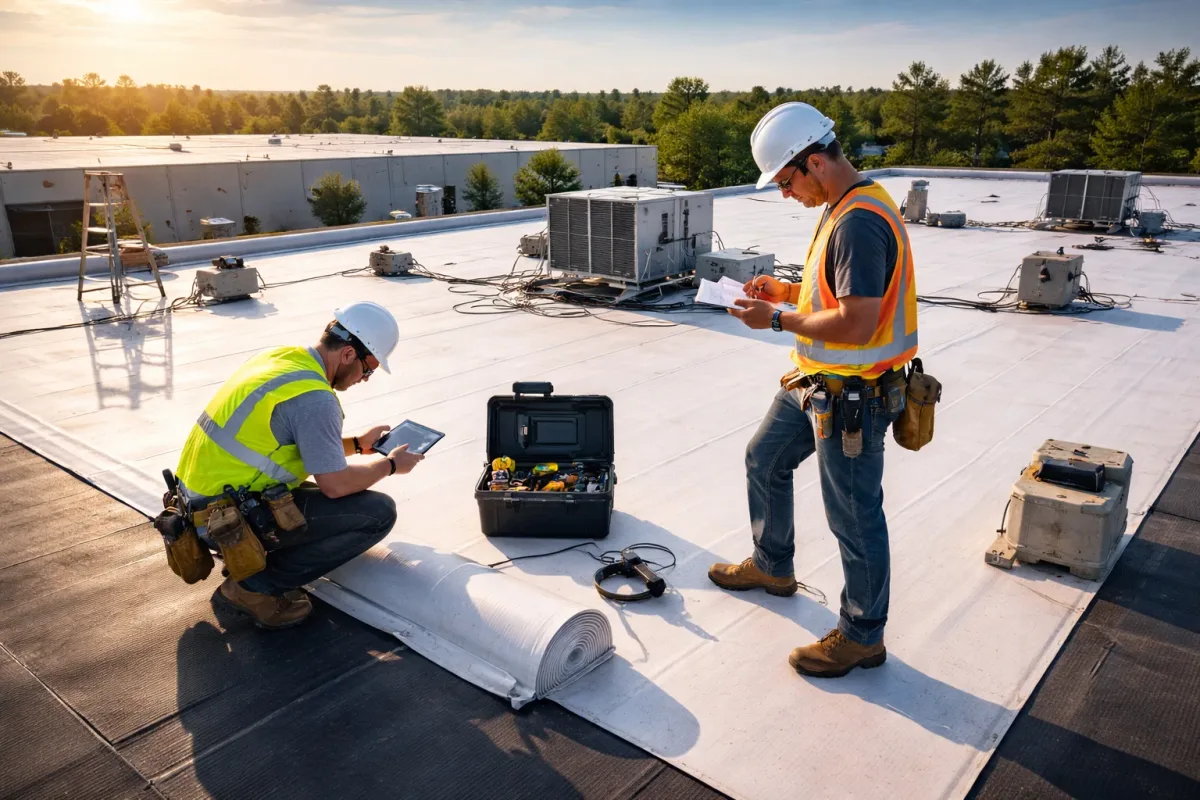
Roofing liability insurance in New York means general liability for injury and damage to others, held alongside the workers’ compensation and disability coverage state law attaches to employers. New York’s Labor Law section 240 places duties on contractors and owners for scaffolding, ladders and other devices on building work, so the wording of each policy deserves a careful read.
What roofing liability insurance covers
General liability is the policy that answers when your work hurts someone who is not on your payroll or damages property that belongs to someone else. The Insurance Information Institute says liability insurance pays damages for which the business is found liable, up to the policy limits, as well as attorneys’ fees and other legal defense expenses. The Institute also says it pays the medical bills of any people injured by, or on the premises of, the business.
For a roofer, that covers a long list of plausible events: a bundle sliding off the eave onto a parked car, debris striking a pedestrian, a torch igniting a parapet, a tarp that fails in a storm and lets water into the building below. It also includes the roof you finished last season, if it leaks and damages the interior. The general liability page explains the policy, and the post on what general liability covers for roofers walks through the exclusions that matter.
New York’s Labor Law section 240
New York has a statute that roofers working in the state should know by name. Section 240 of the Labor Law is titled “Scaffolding and other devices for use of employees.” It applies to all contractors and owners and their agents in the erection, demolition, repairing, altering, painting, cleaning or pointing of a building or structure, and it carves out certain dwelling owners who contract for the work but do not direct or control it.
The section addresses the equipment a roofing crew depends on. Its text lists scaffolding, hoists, stays, ladders, slings, hangers, blocks, pulleys, braces, irons, ropes, and other devices, and it requires that they be furnished and set up so they give proper protection to the people doing the work. Roofing is building work at height, and a re-roof is a repair or alteration of a structure, so a New York roofer should treat the section as part of the legal background of every job.
This post does not describe how courts apply the section, and an owner should not rely on a summary. Ask a New York attorney how it bears on your contracts, and ask your agent how your liability and workers’ compensation policies respond to an injury on a ladder or a scaffold. The post on OSHA fall protection for roofing contractors covers the federal safety rules that sit beside it.
Why the liability wording matters more in New York
A general liability policy is a set of forms, and the forms decide what happens after an injury. Some liability policies can contain exclusions or limitations for bodily injury to employees of contractors or subcontractors, or conditions about the insurance your subcontractors must carry. In a state where a statute places duties on contractors for worker safety devices, those clauses are worth reading before a loss, not after.
Contracts raise the stakes further. A general contractor or building owner in New York can ask to be added as an additional insured, require your policy to respond first, and include an indemnity clause that shifts its liability to you. Whether your policy supports each request depends on its endorsements. Send every insurance exhibit to your agent before you sign. The posts on additional insured status and on what insurance GCs require from roofing subs explain the requests you are likely to see, and an umbrella policy can add limits when a contract asks for more than the base policy carries.
Workers’ compensation for a New York roofing crew
Liability insurance answers for other people. The crew is covered by workers’ compensation, and New York is direct about it. According to the New York State Workers’ Compensation Board, virtually all employers in New York State must provide workers’ compensation coverage for their employees.
The board draws its lines by business form. It says coverage is not required for a sole proprietor who does not have employees, although a sole proprietor may voluntarily cover themselves. It says partnerships, limited liability companies and limited liability partnerships without employees are not required to carry coverage, and that those with employees are. For corporations, it sets out conditions based on the number of officers and who owns the stock, so an owner-run roofing corporation should read that section of the board’s page closely.
Construction gets its own rule. The board says a person working for an employer in the construction industry is only an independent contractor if they meet a specific test set out in the law, and it describes a presumption that a worker injured while performing services for a contractor is the employee of that contractor. The workers’ compensation coverage page explains the policy itself.
Real-World Scenario: A roofing contractor brings in a small crew from another company to finish a commercial re-roof on schedule. The crew’s leader says his men are independent contractors. The roofing owner asks for a workers’ compensation certificate before they start, and none arrives. The owner calls the agent, who reads the New York board’s guidance on construction workers and the presumption it describes, and explains what an injury on that job could mean for the owner’s own policy. The owner holds the crew off the roof until the paperwork comes in.
Disability and Paid Family Leave benefits
New York adds a coverage that roofers from other states can miss. The New York State Workers’ Compensation Board says employees of for-profit employers must be covered by New York’s statutory disability and Paid Family Leave benefits insurance. The board says this coverage is not required for a sole proprietor who does not have employees, and that a sole proprietor may voluntarily cover themselves under such a policy.
This coverage is separate from workers’ compensation. It is not liability insurance, but it belongs on the same checklist, because a roofing company that hires its first employee takes on both obligations at once. Ask your agent to place it with the rest of the program.
New York City’s home improvement license
New York City adds a licensing layer for residential work. The city’s Department of Consumer and Worker Protection says a person or business must have a Home Improvement Contractor license to do construction, repair, remodeling, or other home improvement work to any residential land or building in New York City. A residential re-roof anywhere in the city falls within that description.
The license ties back to insurance. The department’s checklist asks for proof of workers’ compensation, either an insurance certificate from a private insurer naming the department as the certificate holder or a Certificate of Attestation of Exemption from the New York State Workers’ Compensation Board. It also says ACORD forms are not acceptable proof of New York State workers’ compensation coverage. Ask your agent for the form the department accepts. Outside the city, check with the town or county where the job is, because local offices can set their own licensing and permit rules.
The roof you leave behind
A roofer’s liability does not end when the crew drives away. If a roof you installed lets water into the building months later, the claim can fall under the completed operations part of your general liability. In New York, where a building can face lake-effect snow upstate and coastal storms downstate, that exposure follows every job. The post on whether general liability covers a roof leak after the job explains how completed operations coverage works and what to check in the policy. The New York cost guide explains what moves the price, and the New York location page covers the wider market.
Questions to ask about your New York liability coverage
- Does my general liability policy limit or exclude injuries to employees of contractors or subcontractors?
- How does my policy respond to an injury involving a ladder, a scaffold or a hoist on my job?
- Which endorsements do my current New York contracts require, and are they on the policy?
- Is my workers’ compensation in place for every employee, and does my business form change the rule for me?
- Do I have disability and Paid Family Leave benefits coverage for my employees?
- If I work in New York City, what proof of coverage will the Department of Consumer and Worker Protection accept?
For a broader look at what the law requires of roofers, read the post on what insurance roofers legally need, and when you are ready, use the quote page or the roofing insurance hub. Sources: the New York State Senate’s text of Labor Law section 240, the New York State Workers’ Compensation Board’s workers’ compensation coverage page and disability and Paid Family Leave page, the New York City Department of Consumer and Worker Protection’s home improvement contractor checklist, and the Insurance Information Institute’s overview of small business coverage. This post is general education, not legal or tax advice.