
OSHA requires fall protection for roofing crews working six feet or more above a lower level, and for a roofing contractor the rule is two things at once — a legal duty on every job and an underwriting reality that shapes how carriers see the account. This post walks what the standard actually requires and what your compliance posture means for your coverage. It is general education about a federal safety regulation, not legal or compliance advice: OSHA’s rules are detailed and change, so confirm the current requirements with OSHA or a qualified safety professional before you rely on them.
The short version: OSHA’s construction fall-protection standard sets a six-foot trigger and three accepted methods of protection, it has been the most frequently cited OSHA standard of all, and how a roofing business manages it reads directly into how underwriters judge the risk. The workers’ compensation page owns the coverage architecture and the falls from height post owns the coverage mechanics; this post owns the regulatory layer — what the rule requires — and the insurance consequence of how you meet it.
What OSHA’s fall-protection rule actually requires
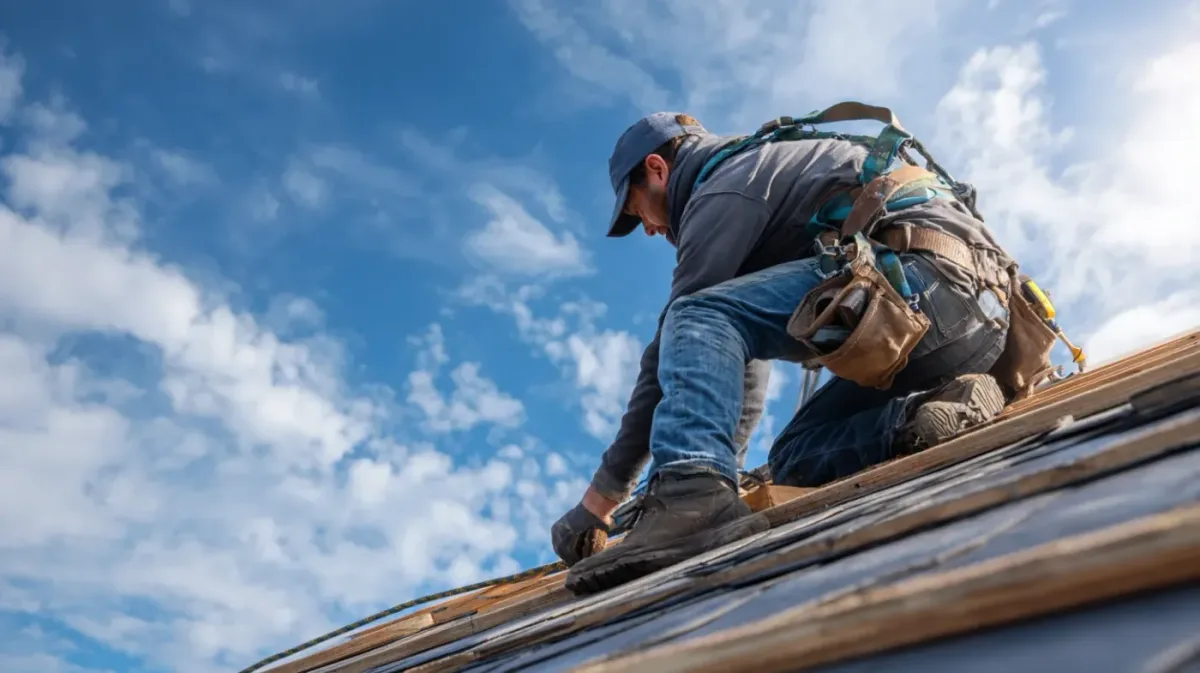
OSHA’s construction fall-protection duty lives in one standard, and its core requirement is a height. Under 29 CFR 1926.501, titled “Duty to have fall protection,” each employee on a walking or working surface with an unprotected side or edge that is six feet or more above a lower level must be protected from falling. The standard names three accepted methods for that general case: a guardrail system, a safety net system, or a personal fall-arrest system — the harness, lanyard, and anchorage that arrest a fall already in progress. Which method fits depends on the roof and the work, but the duty itself is not optional above that trigger height. For a roofing contractor whose crews are on elevated, weather-exposed surfaces all day, this is the rule that governs the core of the work.
Low-slope versus steep roofs: the roof-specific provisions
The standard does not treat every roof the same, and roofing is one of the few trades it calls out directly. Beyond the general six-foot rule, 29 CFR 1926.501 sets specific provisions for roofing work — one addressed to low-slope roofs (paragraph (b)(10)) and another to steep roofs (paragraph (b)(11)) — because the fall exposure and the practical protection methods differ between a flat commercial deck and a pitched residential roof. The details, conditions, and any exceptions are exactly the kind of thing to read against the actual job rather than summarize from memory, which is why the honest instruction on a regulatory post like this is to work from the standard itself. The point for an owner is that the rule is roof-aware: the protection appropriate for a commercial low-slope job and a steep residential job are not assumed to be identical.
Federal OSHA, state plans, and which set of rules applies to you
Which fall-protection rules govern your crews depends partly on where you work, because federal OSHA is not always the direct regulator. Alongside federal OSHA, many states run their own OSHA-approved State Plans — OSHA’s State Plans page lists twenty-two states and territories with plans covering private-sector employers. A state plan must be at least as effective as federal OSHA, and it may adopt standards that are stricter or that reach further than the federal rule. For a roofing contractor, the practical takeaway is that the six-foot federal requirement is a baseline, and the state you operate in may hold you to more. If you work across state lines, it is worth confirming whether each state runs its own plan and what its fall-protection requirements are, rather than assuming the federal standard is the whole picture — another reason the honest instruction on a regulatory topic is to verify against the rule that actually governs your jobsite.
Why this is the rule roofing contractors get cited for
Fall protection is not a peripheral standard — it is the one OSHA cites more than any other. On OSHA’s published list of the top 10 most frequently cited standards, Fall Protection — General Requirements (29 CFR 1926.501) ranked number one across all industries in fiscal year 2025. OSHA also states, on its fall protection page, that falls are “among the most common causes of serious work related injuries and deaths.” Put those together and the picture for roofing is plain: the trade lives at the exact intersection of the most-cited standard and one of the most serious injury exposures on any jobsite. That is not a reason to panic; it is a reason to treat fall protection as a managed system rather than a box to check, because both the regulator and your insurance carrier are looking at how you handle it.
What a fall-protection program looks like in practice
Meeting the rule is more than keeping harnesses in the truck; it is a system a crew actually runs. A real fall-protection program pairs the right equipment — guardrails, nets, or personal fall-arrest gear with sound anchorage — with a written plan, trained crews who know how to use and inspect the gear, a competent person overseeing the work, and records that the training and inspections happened. The equipment stops a fall; the program is what keeps the equipment reliably present and correctly used on every roof, not just the one being inspected. That distinction is where a lot of contractors quietly fall short: the gear is in the truck, but the plan, the training log, and the inspection records are not there to prove it was used. Building the program is a safety decision first — and, not incidentally, it is the part of your operation an outsider can actually verify.
Real-World Scenario: Two roofing contractors bid the same commercial re-roof. Both own harnesses and anchors. One keeps a written fall-protection plan, dated training records for every crew member, and a simple inspection log; the other keeps the gear but none of the paper. When each applies for coverage, the underwriter sees two very different accounts — not because one bought different equipment, but because one can show a managed program and a clean enforcement history while the other cannot. Same trade, same tools; the documented program is what a carrier can actually read, and it shapes how the risk is judged.
The insurance layer: your compliance posture is an underwriting reality
How you manage fall protection reads directly into how a carrier judges your risk — quietly, qualitatively, but really. No carrier publishes a “fall-protection surcharge,” and this post names no premium figures because none would be honest. What is true is structural: a roofing account is defined by the fall exposure, and an underwriter assessing it looks hard at how the contractor manages that exposure. A documented program, current training, and a clean enforcement record signal a risk that is being run deliberately; a thin safety file and a pattern of citations signal the opposite. The mechanism is claims — the fall-protection practices OSHA requires are the same ones that prevent the severe, long-tail workers-compensation losses a roofing business is rated so heavily for. Prevent the fall and you prevent the claim; prevent the claim and the loss history a carrier prices stays clean. That is why the safety file and the workers’ compensation program get read together, and why compliance posture is part of the underwriting picture even though it never appears as a line on a quote.
Where fall protection meets your coverage
OSHA is the prevention side of the roofing trade’s defining exposure; insurance is the response side, and a roofing business needs both working together. The regulatory duty and the coverage are not substitutes: fall protection is what keeps a crew member off the ground, and workers’ compensation is what responds when a fall happens despite it — the mechanics of which the falls from height post walks in full. Run the two as a pair. Build the fall-protection program because it keeps your people safe and because it is the law above the trigger height, and carry the coverage because no program eliminates the risk entirely. When you are ready, start a quote and tell us how your crews work — residential steep-slope or commercial low-slope — read the workers’ compensation page to see how the coverage is built, or browse the coverage overview to see where each line sits. And confirm the current fall-protection requirements with OSHA or a qualified safety professional, because the rule is detailed and this post is education, not compliance advice.