

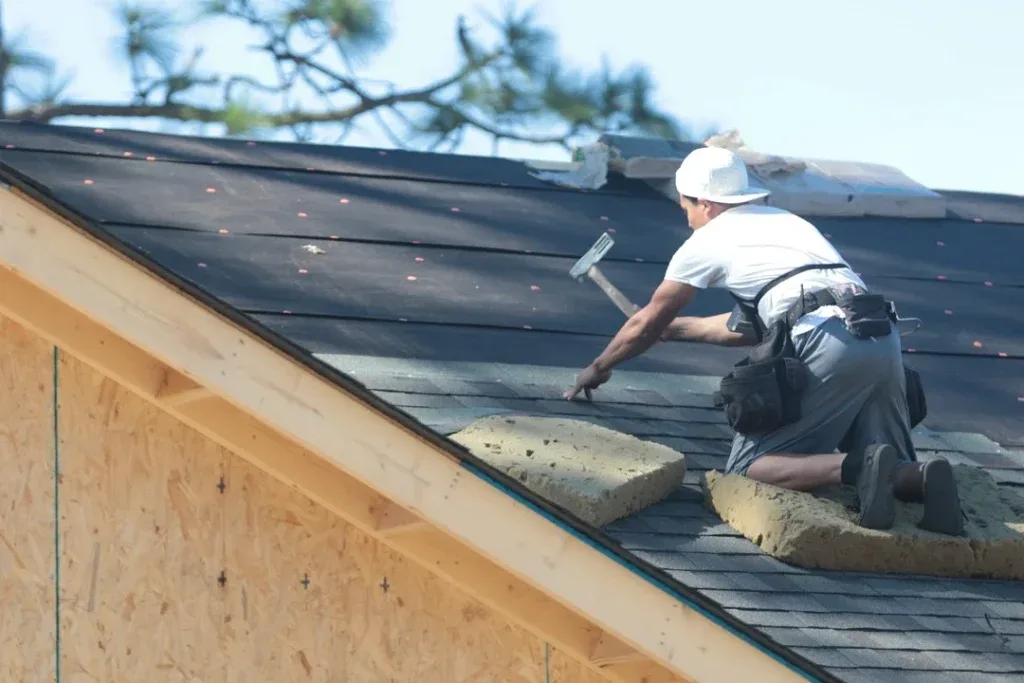
To get roofing contractor insurance in Indiana, gather your payroll, work description, vehicle list and loss history, then have an agent who places roofing take that file to insurers that write the class. The Indiana Workers’ Compensation Board says the law requires most businesses to have worker’s compensation insurance, so the crew policy comes first.
Start with what Indiana’s workers’ comp board says
An Indiana roofer with a crew begins with the workers’ compensation question, because the state has already answered part of it. The Indiana Workers’ Compensation Board tells workers that the law requires most businesses to have worker’s compensation insurance, and that they are covered from the first day they are on the job. A roofing crew’s first day on a pitched deck is inside that promise.
The board’s compliance page goes further. It reproduces IC 22-3-5-1, which requires an employer to insure and keep insured the employer’s liability under the Act, or to furnish to the board satisfactory proof of the employer’s financial ability to pay. For a small roofing company, the practical route is the first: a workers’ compensation policy from an insurer that writes roofing. The board’s director of compliance also says the board has begun to scrutinize filings for compliance with the Act, which is a reason to keep your policy and your records in order rather than a reason to panic.
The workers’ compensation coverage page explains what the policy pays for, and the post asking do I need workers’ comp for my roofing crew sorts out who on an Indiana job site counts as part of your payroll and who does not.
Independent contractors and the clearance certificate
Roofing companies can lean on subcontracted crews, and Indiana has a specific paper trail for them. The board’s independent contractor page quotes Indiana Code 22-3-6-1(b)(7), under which a person is an independent contractor and not an employee for the Act’s purposes if the person is an independent contractor under the guidelines of the United States Internal Revenue Service. Calling someone a subcontractor does not make it so; the test is in the statute.
The certificate side runs through the Indiana Department of Revenue. The department says it issues the workers’ compensation clearance certificate to individual taxpayers who are independent contractors, or who are not required to carry worker’s compensation insurance under the Act. It lists its conditions, including that all Indiana tax returns must be filed and up to date and that outstanding tax delinquencies must be paid in full. The statute posted on the board’s compliance page, IC 22-3-2-14.5, says the independent contractor must obtain clearance from the department of state revenue before issuance of the certificate.
What you collect from the subcontractors you hire
The same statute puts a duty on the roofer who hires. The text posted by the Indiana Workers’ Compensation Board says a person who contracts for the services of an independent contractor must secure a copy of a stamped certificate of exemption from the person hired. The statute also provides that the filing can be verified on request.
Build that into the way you hire. Before a subcontracted crew climbs onto a roof, collect either a current certificate of workers’ compensation insurance, if the subcontractor has employees and a policy, or the stamped certificate of exemption, if the subcontractor is an independent contractor without a policy. Keep the document with the job file. At the end of the policy year, your insurer can audit how subcontracted labor was handled, and paper collected on the first day is far easier to produce than paper chased afterward. The board’s website also lists online services titled “Confirm Employer’s Worker’s Comp Coverage” and “Contractor Search” for owners who want to check. General contractors ask you for this same proof, as the post on what insurance GCs require from roofing subs explains.
Local rules in Rushville, Indianapolis and the rest of the state
Workers’ compensation is a state matter, but the permit counter is local. Indiana cities, towns and counties can set their own contractor licensing, registration or permit requirements, and a permit office can ask for proof of insurance before it issues anything. This post does not list those local rules, because each office publishes its own.
The practical step is a phone call. Whether your shop is in Rushville, Greenwood or Fort Wayne, call the building or permit office for each town where you plan to work and ask what it needs from a roofing contractor. Then send any insurance requirement to your agent, so the certificate matches what the office expects. The Indiana location page carries the wider picture for the state, and the post asking do roofing contractors need a license explains how licensing differs from insurance.
The rest of the coverage an Indiana roofer weighs
Workers’ compensation covers the crew. The other policies answer for everything else that can go wrong on and off the roof.
General liability answers when a customer, a passer-by or a neighbor’s property is hurt by your operations, and that includes a finished roof that lets water in after the crew has gone. The general liability page explains it. Commercial auto covers the trucks and trailers. On the vehicle side, the National Association of Insurance Commissioners notes that personal auto insurance usually doesn’t cover vehicles used for work, and it says most states require drivers to carry a minimum amount of liability coverage; the post asking is commercial auto insurance required for a roofing truck covers it. Contractors equipment protects nailers, compressors and ladders, and an umbrella can sit above the liability policies when a contract asks for higher limits. Pollution and professional liability are exposures to ask your agent about, not assumptions.
The order matters less than the fit. A Rushville shop that does residential re-roofs and the occasional barn has a different exposure from an Indianapolis contractor on commercial low-slope work, and the policies should be written around the work each really does. Describe your jobs plainly, including the ones you take only now and then, so the coverage on paper matches the coverage on the roof.
Real-World Scenario: A roofing owner in a small Indiana town hires a small crew from a neighboring county to help with a run of hail repairs. The crew’s leader says they work for themselves. The owner asks for a workers’ compensation certificate or a stamped certificate of exemption before the first job, and the leader produces neither. The owner calls the agent, who explains how the insurer will treat that labor at audit. The owner who asked on the first morning made the decision with the facts in hand.
What to gather before you ask for a quote
An underwriter prices what it can see. A complete file from an Indiana roofer includes:
- Payroll for the last year and an estimate for the next, split by role, with roofers separated from office and sales staff.
- A written description of the roofing you do: steep-slope or low-slope, residential or commercial, re-roofs, repairs, any torch-applied work.
- Every truck, trailer and driver, with the address where each vehicle is kept.
- The value of equipment and tools that travel to jobs.
- Your loss runs, and a plain note on what happened in each claim and what changed afterward.
- A list of subcontractors, with a certificate or stamped exemption for each.
- Any contract or bid package with insurance requirements attached.
The post on how to get a roofing insurance quote explains why each item matters, and the Indiana cost guide explains what moves the price.
How placement works once the file is ready
An independent agent who places roofing sends the file to insurers whose appetite fits the work you describe. A residential re-roofing company and a commercial low-slope contractor can land with different insurers, because each insurer decides which kinds of roofing it wants to write. If an insurer declines, ask whether the reason was the class or something in your file, because only the second is something you can fix.
When the policies are bound, ask for certificates right away and check that the business name on each policy matches the name on your contracts and permits. The post on being an insured roofing contractor explains what a certificate proves and what it does not.
Questions to ask an Indiana agent
- Which insurers you work with write roofing workers’ compensation in Indiana, and which of them will see my file?
- How will my subcontracted labor be treated at the premium audit?
- What should I collect from each subcontractor before a job starts?
- Does my workers’ compensation policy list every state where my crews will work?
- Are my trucks and trailers on a commercial policy in the business name?
- Which local permit offices I work with have asked for insurance proof, and does my certificate match?
When you are ready, use the quote page to start. Sources: the Indiana Workers’ Compensation Board’s compliance page, eligibility page and independent contractors page, the Indiana Department of Revenue’s workers’ compensation clearance page, and the National Association of Insurance Commissioners’ auto insurance page. This post is general education, not legal or tax advice.