

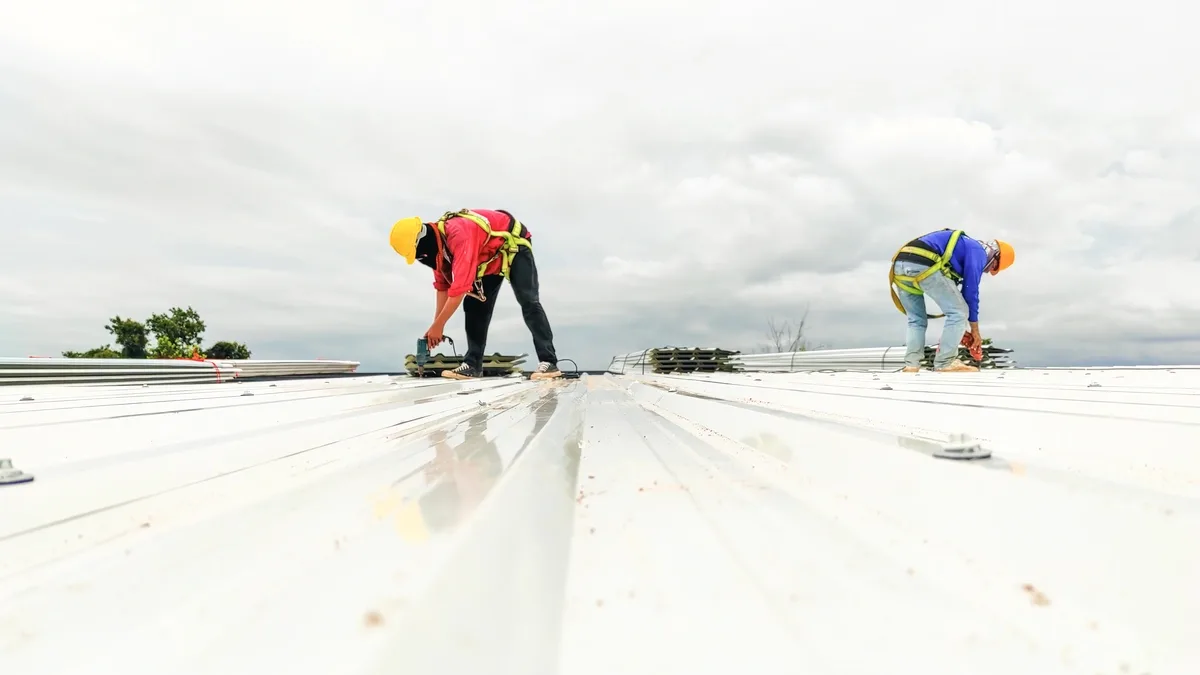
General liability will not pay to tear off and redo your own defective work when a roof you installed simply fails — the standard policy treats fixing your own faulty workmanship as a cost of doing business, not a covered third-party claim. What the same policy does pay for is the damage that failure causes to someone else’s property.
The short version: the standard general liability form carries two exclusions that keep it from funding the redo of your own work, and owners misread them because the very same policy pays readily for the damage that work does to a building and its contents. This post draws that line — the redo you pay for versus the third-party damage the policy covers — and points you to the covered side in its sibling post on the leak that damages the building and its contents. The general liability page owns the coverage architecture; this post is about the single distinction owners get wrong most often.
What ‘your work’ means on a general liability policy
‘Your work’ is a defined term in the policy, and it is broad: the roofing work you perform, the materials and equipment you furnish in connection with it, and the representations you make about that work’s quality. General liability is third-party insurance — it is built to pay when your operations cause bodily injury or property damage to other people and their property, not to guarantee that the work you did came out right.
That framing is the whole key to this topic. Because the roof you install is ‘your work,’ the policy draws a hard line around it: harm your work does to others is inside the tent, but restoring the work itself when it turns out to be defective is not. Understanding that the roof is treated as your product, not as third-party property, is what makes the two exclusions below read the way they do.
Why general liability won’t pay to redo a defective roof
Two exclusions in the standard occurrence form — the one commonly known as CG 00 01 — do the work here, and both point the same direction.
- The ‘Damage To Your Work’ exclusion, which in the standard form is exclusion l., excludes property damage to ‘your work’ arising out of it and included in the products-completed operations hazard. In plain terms: a finished roof that fails because of how it was built is your own work, and repairing or replacing it is not what this policy funds.
- The ‘Damage To Property’ exclusion, exclusion j., contains a faulty-workmanship subpart — j.(6) — that excludes the particular part of any property that must be restored, repaired, or replaced because your work was incorrectly performed on it.
Read together, they say the policy will not pay to tear off and redo the roof simply because the roof itself did not hold up. That is deliberate. Redoing your own defective work is a business risk you control through your workmanship, your crews, and any warranty you offer — it is not a fortuitous third-party loss, and general liability is not designed to absorb it. Editions and exact forms vary by carrier, so the exclusion letters here are a starting point to confirm against your own policy, not proof of what is attached.
The part versus the whole: how j.(5) and j.(6) draw the line
The ‘Damage To Property’ exclusion is more surgical than it first appears, and the surgery matters. Its subparts speak to that particular part of the property, not the whole structure. Subpart j.(5) addresses the particular part of real property you are performing operations on at the time — the section actively under your hands. Subpart j.(6) addresses that particular part of any property that must be restored, repaired, or replaced because your work was incorrectly performed on it.
The practical effect is that the exclusion carves out the defective part you worked on, not necessarily everything around it. It is aimed at the work itself, which is exactly consistent with the ‘Damage To Your Work’ exclusion above. You may see these subparts referred to by title rather than by their letters on a given carrier’s form; editions and exact wording vary by carrier, so if a subpart is named in your policy, read the language attached rather than relying on the label alone.
The subcontractor exception that can change the result
There is an important carve-back inside the ‘Damage To Your Work’ exclusion, and for a roofing contractor who hires subs it can flip the outcome. The exclusion does not apply if the damaged work — or the work out of which the damage arises — was performed on your behalf by a subcontractor. In other words, when part of the job was done for you by a sub and that sub’s work is the source of the completed-operations damage, the exclusion can step aside and leave the claim inside coverage that would otherwise be excluded as your own work.
That is a meaningful piece of how general liability responds for contractors who do not self-perform every scope. It is also a piece a policy can narrow: an endorsement can restrict or remove the subcontractor exception, and a policy written that way behaves very differently on a sub-driven claim than one that keeps the carve-back intact. Because the presence and breadth of that exception is not guaranteed, this is precisely the kind of provision worth confirming on your own policy rather than assuming it reads the standard way.
The other side of the line: the third-party damage GL does pay
Here is where owners most often go wrong. The exclusions above deny funding to redo your own work — they do not deny the damage that failed work does to other property. When a roof you installed lets water into the building and that water ruins ceilings, finishes, inventory, or equipment below, that resulting damage to third-party property is the covered side of completed operations. The policy will not buy you a new roof because the old one failed, but it can respond to the harm the failure caused to the building and its contents.
That covered side is the whole subject of the sibling post on the leak that damages the building and its contents — the covered side. The line between the two is the single most useful thing to hold onto: your work is excluded, the damage your work causes to others is not.
Real-World Scenario: A roofer re-roofs an occupied building, and a season later a section fails and leaks. The membrane and decking the crew installed have to be torn off and redone, and the water has also soaked through and ruined the finished ceilings, wiring, and stored inventory in the space below. On the tear-off-and-redo of the roofer’s own defective work, the standard form does not pay — that is the roofer’s cost to carry. On the water-damaged ceilings, wiring, and inventory belonging to the building owner, the completed-operations coverage can respond, because that is third-party property harmed by the roofer’s work rather than the work itself. Same event, two different answers — which is exactly what the exclusions are built to produce.
Why owners misread the faulty-workmanship exclusion
The confusion is understandable, because the denial and the coverage live in the same policy and arrive from the same failed roof. An owner sees the whole event as one claim and expects general liability to cover all of it or none of it. Neither is how the form works. It declines the redo of your own work and can pay for the damage that work does to someone else — and it is entirely normal for a single loss to split down that seam, with the roofer absorbing the redo and the policy answering the third-party damage.
This is also why general liability should never be confused with a workmanship warranty, a performance bond, or a substitute for doing the work correctly the first time. The way to keep the exclusion from surprising you is to know, before a loss, which side of the line any given failure falls on. The same distinction sits underneath the additional-insured demands a general contractor makes, covered in the post on additional insured for roofing contractors, because those endorsements extend the covered side to the GC — not the excluded redo of your work.
Read your policy before you assume the redo is covered
The takeaway is direct: general liability will not pay to tear off and redo your own defective roof, because the standard form treats that as a business cost through the ‘Damage To Your Work’ exclusion and the faulty-workmanship subpart of the ‘Damage To Property’ exclusion — but the same policy can answer the third-party damage that failure causes to the building and its contents. Confirm whether your policy still carries the subcontractor exception, read the actual exclusion language rather than the label, and know which side of the line a given failure falls on before it happens. The distinction bites hardest on the commercial and industrial roofing work where completed-operations tails run long. When you are ready, start a quote, read the full general liability page for how the covered completed-operations side actually works, or browse the coverage overview to see where each line sits.