
Roofing crews work at height, on pitched and slick surfaces, in wind and weather — and a fall is the severe injury the whole line is built around. When a roofer is hurt on the job, workers’ compensation is the coverage that responds, not general liability. This post explains why, and where the line’s rules bend.
The short version: workers’ compensation covers your own crew for job-related injury — medical care and a portion of lost wages — while general liability answers third parties, never your workers. Roofing is among the highest-severity workers-comp classes of any trade precisely because of the fall exposure, which makes this the line the business is built around. The workers-compensation page owns the coverage architecture; this post is about why the fall exposure makes it central and where the seam with general liability falls.
Why roofing sits among the highest-severity workers-comp classes
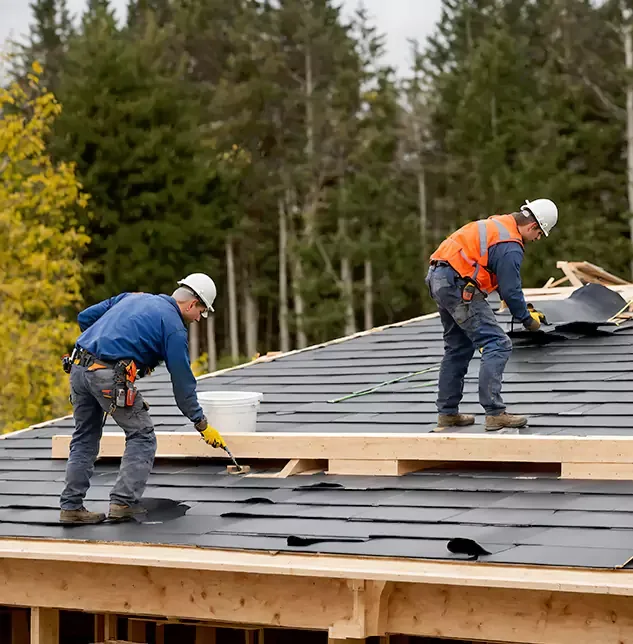
Because the work happens at height on surfaces that shed water and give way, the injuries a roofing crew risks are among the most severe of any trade — and severity, not just frequency, is what drives this line. Roofing puts people on steep, elevated, weather-exposed surfaces all day, often near edges, skylights, and unfinished decking. When something goes wrong the result is rarely minor: a fall from height tends to produce serious, sometimes life-altering injury. That severity is why workers’ compensation sits at the center of a roofing contractor’s program and why underwriters treat the trade as one of the more demanding classes to write. It is not a knock on the work — it is an honest reflection of what gravity does on a roof, and why the coverage that pays for a hurt roofer’s care matters more here than in almost any other trade.
The seam: a fall is workers’ comp, not general liability
When your own crew member falls, workers’ compensation responds; general liability does not, because general liability answers injury to third parties, not to your employees. This is the seam that trips people up. General liability is built to answer harm your work does to other people and their property — a passerby, a client, the building below. It specifically does not cover injury to your own employees; that is what workers’ compensation exists to do. So the signature roofing loss — a crew member falling from the roof — routes to workers’ compensation every time, not to the general liability policy. Confusing the two is a costly mistake, because a business that assumes general liability will catch a crew injury discovers the gap at the worst possible moment. The additional insured for roofing contractors post makes the same point from the other direction: the endorsements that extend your general liability to a general contractor still do not reach your own crew.
What workers’ compensation covers when a roofer falls
It pays for the injured worker’s medical treatment and a portion of lost wages while they recover, and it does so regardless of who was at fault. Workers’ compensation is a no-fault line: when a crew member is hurt on the job, it responds to their medical care and replaces part of their lost income during recovery, without the injured worker having to prove the employer did something wrong, and without the employer facing most injury lawsuits from that worker in return. For a serious fall, that can mean sustained medical treatment and an extended time away from the roof, which is exactly the kind of severe, drawn-out loss the line is designed to absorb. It also protects the business, because the alternative to a functioning workers’ compensation policy is direct exposure to those costs.
Real-World Scenario: A crew member loses footing on a steep, frost-slicked slope early in the morning and falls, suffering serious injury that keeps them off the roof for months. Workers’ compensation responds to the medical care and replaces a portion of the lost wages during recovery — no fault to prove on either side. General liability never enters the picture, because the injured party is the roofer’s own employee, not a third party. The fall is precisely the loss the workers-compensation line is built to absorb.
OSHA, fall protection, and loss control
The Occupational Safety and Health Administration sets the fall-protection standards roofing crews work under, and a serious fall-protection program is both a legal duty and the most direct way to lower this exposure. Federal fall-protection rules for construction come from the Occupational Safety and Health Administration (OSHA), the agency that enforces workplace-safety standards on the job. For roofing, fall protection — guardrails, personal fall-arrest systems, anchor points, and trained use of them — is the front line against the exposure this whole line of coverage exists for. Insurers pay close attention to it: a contractor with a genuine, documented fall-protection program and a clean safety culture is a very different risk from one without, and loss control is where a roofing business has the most leverage over its own workers-compensation outcome. The point is not paperwork; it is that the injury workers’ compensation pays for is the injury a real fall-protection program is built to prevent.
Monopolistic states: where the coverage comes only from the state fund
In a handful of states, you cannot buy workers’ compensation from a private carrier at all — it comes only through a state-run fund. In most states, workers’ compensation is a private-market line: you buy it from an insurer alongside your other coverages. Four states work differently. In North Dakota, Ohio, Washington, and Wyoming, workers’ compensation is written only through the state fund, not a private carrier — these are the monopolistic states, and a roofing contractor operating there obtains the coverage through the state system rather than the private market. Everywhere else, it is a private-market line that sits alongside your general liability, commercial auto, and the rest of your program. If you work across state lines, it is worth confirming how each state you operate in handles the coverage, because the monopolistic states change where the policy comes from.
What actually drives your workers’ compensation cost
Two things move a roofing contractor’s workers’ compensation cost more than anything else: how the payroll classifies, and what the loss record looks like. Roofing work carries its own classification, and because the class reflects the severity this trade is known for, the payroll assigned to roofing operations is rated accordingly — which is why getting the classification right, and splitting out genuinely lower-hazard payroll where the rules allow, matters. On top of the classification sits your own history: an experience modifier that reflects how your past claims compare to what a business your size would be expected to run, so a clean, well-documented safety record earns a better position over time while a run of serious falls works the other way. The durable levers are operational — a real fall-protection program, trained crews, prompt claim reporting, and a return-to-work approach that gets an injured roofer back to suitable duty rather than leaving a claim open — all of which shape the severity and duration a carrier ultimately prices. None of that is a number anyone can quote before seeing the operation; it is the set of inputs that decides where a roofing contractor lands.
What workers’ comp does not reach
It covers your crew’s job injuries — not third-party claims, not your vehicles, not your equipment. Workers’ compensation is specifically your employees’ line. It does not answer a third party your work harms — that is general liability. It does not cover your vehicles, which run through commercial auto, or your tools, harnesses, and staged materials, which run through contractors equipment. Keeping the lines straight matters because a roofing business leans on all of them at once, and each answers a different kind of loss. The fall from the roof is the one that belongs, unmistakably, to workers’ compensation.
Get the line roofing is built around right
The takeaway is direct: roofing is among the highest-severity workers-comp classes precisely because the crew works at height, a fall is the severe injury the line is built to absorb, and that injury is workers’ compensation — never general liability. Get the coverage in force, invest in the fall-protection program that lowers the exposure, and confirm how each state you work in provides it. Coverage depends on your specific policy and state, so it is worth confirming rather than assuming. When you are ready, start a quote and tell us about your crews and the residential roofing work they do, read the full workers’ compensation page to see how the line works, or browse the coverage overview to see where each policy sits.