

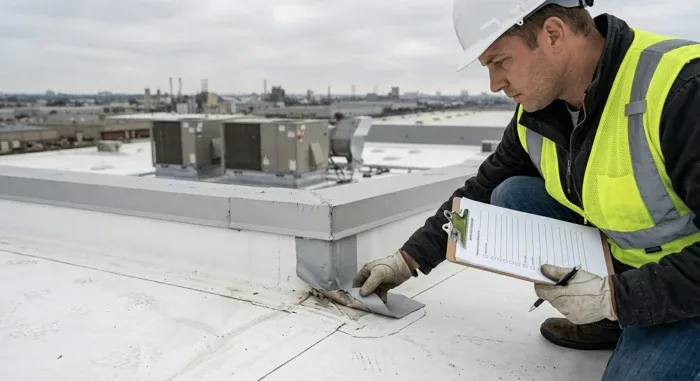
There is no published price for roofing contractor insurance in Florida, and the first thing a carrier prices here is the wind. Florida is the most hurricane-exposed state in the country, so a roofing operation’s storm-season loss record and the wind-rated roofs it leaves behind shape the cost before payroll or trucks ever enter the conversation. What a carrier actually does is build the number from your specific operation — never a rate card.
That answer frustrates owners who just want a number, but it is the honest one, and the Florida drivers are specific enough that understanding them is worth far more than a fake average. A residential shingle crew in Tampa and a commercial low-slope operation in Miami are the same trade only in name. Below is what moves the number, starting with the exposure that leads every Florida roofing submission.
Hurricane wind leads every Florida roofing submission
Florida pairs peninsula-wide tropical wind and uplift with pervasive coastal salt corrosion, and that combination is the backdrop a carrier reads first. Wind concentrates roofing losses into a defined season, which shapes cost in two ways: it drives demand, so storm-recovery revenue can surge and then settle, and it clusters claim activity, so your loss history carries unusual weight. The property side of the market is shaped further by the government-created Citizens Property Insurance Corporation, the state’s residual property insurer of last resort — a state entity, not a private carrier — which tells you how stressed the wind-exposed property market here is.
For a roofing contractor that means the story runs from the climate to your record to the two lines that actually decide your premium. For the full market and regulatory picture, see our Florida roofing contractor insurance page — that page is the overview, and this one is the cost explainer that companions it. The market itself is overseen by the Florida Office of Insurance Regulation.
Why there is no published price
A premium is the output of an underwriting model, not a sticker. The carrier takes your specific exposures — how many people you employ and what they do on the roof, the revenue behind your completed work, your loss history, and the limits your contracts require — and prices each line against them. Change any input and the number moves. Florida makes a statewide average especially misleading, because a single-county residential re-roofer riding storm demand and a statewide commercial contractor carry genuinely different pictures. For a roofing contractor the cost is built mostly from two things: the crew working at height, and the roofs it leaves behind on a wind coast. And because Florida law channels stressed wind risk through a state residual entity rather than the open market, the private carriers that do want roofing here underwrite the class carefully — another reason a real submission beats a posted average.
The Certified-or-Registered roofing license
Florida is one of the states that actually licenses roofers, and which license you hold shapes the exposure a carrier reads. The Construction Industry Licensing Board within the Department of Business and Professional Regulation issues a roofing contractor credential as either Certified — valid statewide, earned by state exam — or Registered, limited to the local jurisdiction that granted it. A statewide certified operation working multiple markets and a single-county registered one working locally carry different work footprints, and a carrier prices the footprint. Holding the credential that matches the work you actually do is part of an accurate quote, not a line item. It also signals which contracts you can sign, since general contractors and public work often require a certified credential, and the additional-insured and higher-limit obligations that ride along with those contracts are themselves cost inputs a carrier weighs.
Crew payroll and the work at height
Payroll is usually the single biggest driver for a roofing contractor, because it scales both your workers compensation and a large part of your general liability. It is not just the dollar figure — it is which work the payroll covers. Roofing is among the highest-severity comp classes of any trade because the crew works at height, and a fall is the severe injury the line is built for. That is why the Occupational Safety and Health Administration treats fall protection as the defining roofing safety regime. On a hurricane coast, where re-roof volume spikes hard after a storm and crews scale up fast, your fall-protection discipline is read as closely as your payroll.
The completed-operations tail on the wind coast
Your revenue is a rating basis for general liability, but for a roofing contractor the exposure that defines the class is completed operations — the work you leave behind. A roof keeps existing after your crew is gone, and in Florida that installed roof is judged against the next hurricane. A roof that fails downstream can become a serious third-party property-damage or injury claim long after the job closes, and the completed-operations side of general liability is the signature line built to answer for it. Because a wind-rated installed roof carries such a long tail, your revenue and your workmanship-and-inspection record are inputs a carrier weighs closely. This is the roofing contractor’s defining cost driver.
Storm season, the residual market, and your loss history
Florida concentrates loss activity into hurricane season more sharply than almost anywhere, and that shapes cost through your record. A residential steep-slope crew carries a fall-and-completed-operations profile driven by storm volume; a commercial and industrial low-slope operation carries a different signature, with torch-down and hot-work fire exposure during the job and larger contracts pulling in additional-insured and higher-limit requirements. Both leave finished roofs that must survive the next season, and the stressed property market behind the Citizens residual entity is a reminder of how much the wind matters here. A carrier reads your storm-season claims history against that backdrop closely, and a roofer who can show clean workmanship and documented inspections through an active hurricane year gives an underwriter a reason to price it sharper than a competitor who cannot.
Real-World Scenario: A Tampa residential crew rides an active hurricane season, its trucks and payroll surging to keep up with re-roofs, while a Miami commercial contractor runs low-slope torch-down work on larger flat-roof projects through the summer heat. Both leave finished, wind-exposed roofs that must perform through the next storm, but an underwriter reads them differently — the residential crew’s exposure rides storm-driven volume and fall risk across many pitched roofs, the commercial contractor’s on hot-work fire risk and fewer, larger low-slope jobs. Same Florida, same roofing class — but the work mix and the completed-work picture price differently. The owner who can describe that picture clearly gets a sharper quote.
Trucks, tools, and staged materials
Beyond the crew and the completed work, a carrier prices what you drive and what you own. Commercial auto covers the trucks and trailers hauling crews, tear-off debris, and materials, and it grows with the size of your rolling stock. Contractors’ equipment — inland marine — covers the tools, harnesses and fall-protection gear, standing-seam and metal-forming machines, and the materials you stage on the jobsite and in transit. For a roofing contractor these are real but usually secondary to the crew and the completed-operations tail, and they are drivers you control by scheduling your trucks and equipment to their real value rather than guessing.
Getting an accurate Florida quote
The path to a real number is to describe your real operation. Tell a broker your crew payroll and the work it covers, your revenue and the kind of roofs you leave behind, your license status, your work mix across steep-slope and low-slope and specialty, your trucks and equipment values, your storm-season claims history, and the limits your contracts require. From there a carrier with genuine roofing appetite can price it. The full coverage overview shows how each line — including the umbrella your larger contracts may require — fits together. When you are ready, start a quote and tell us how your crews work, or see the Florida roofing contractor insurance page for the market picture behind these drivers. The number at the end will reflect your business, which is the only number worth having.